Category: Uncategorized

  • Are SEO Services Worth It? What You Need to Know

    Are SEO Services Worth It? What You Need to Know

    If your customers use Google or Bing to find products or solutions like yours, then yes – SEO is worth it. A well-crafted SEO strategy (organic optimisation plus targeted paid search) can deliver steady traffic, leads and sales for multi-brand businesses. At Seek Marketing Partners, we take a data-led approach to SEO that’s “built to grow your business” – increasing traffic, leads and revenue.

    In this post, we’ll explain how organic and paid SEO work, the benefits of each, and how they can combine to give you a strong ROI.

    Organic vs. Paid SEO Services

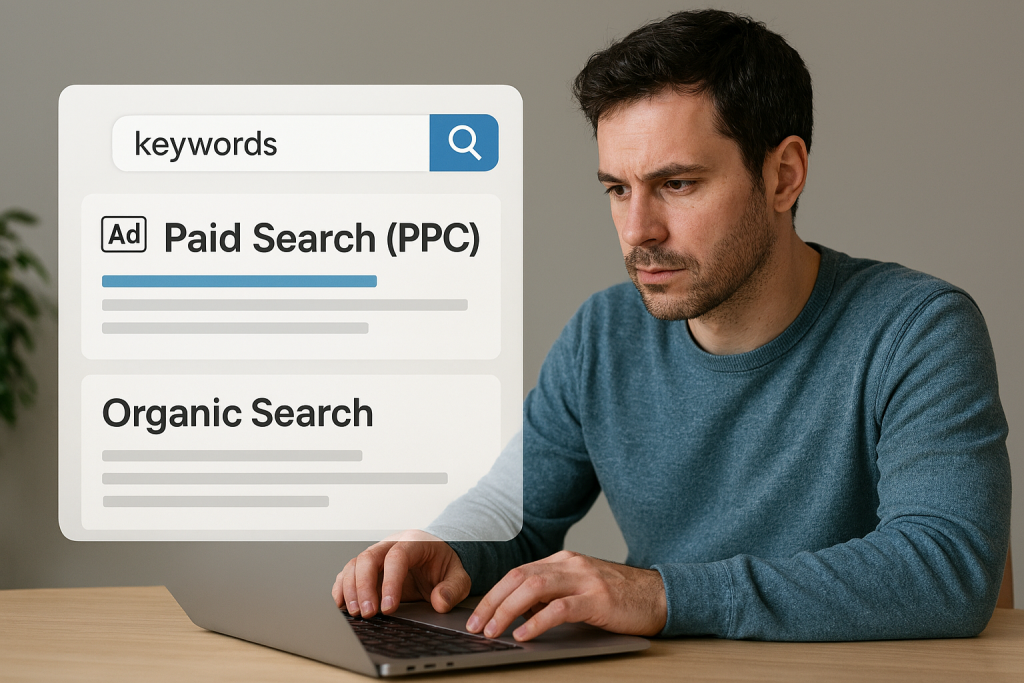
    SEO services come in two flavours. Organic SEO (natural optimisation) means improving your site’s content, structure and authority so it ranks higher in unpaid search results. This involves keyword research, content creation, technical fixes and link-building. It can take several months to see big gains, but once your site ranks well, it earns traffic at no cost-per-click. 

    Paid search (PPC), by contrast, involves buying ads on search engines. It gives you instant visibility for chosen keywords, but you pay for every click. For example, PPC ads appear above organic listings and drive immediate visitors, whereas organic SEO takes time but has no click fees.

    In practice, most successful campaigns use both. Search engine marketing (SEM), the combination of SEO and PPC, captures more opportunities. As one study reports, businesses that typically spend around 10% of their marketing budget on SEO recognise that organic search drives much of their traffic. 

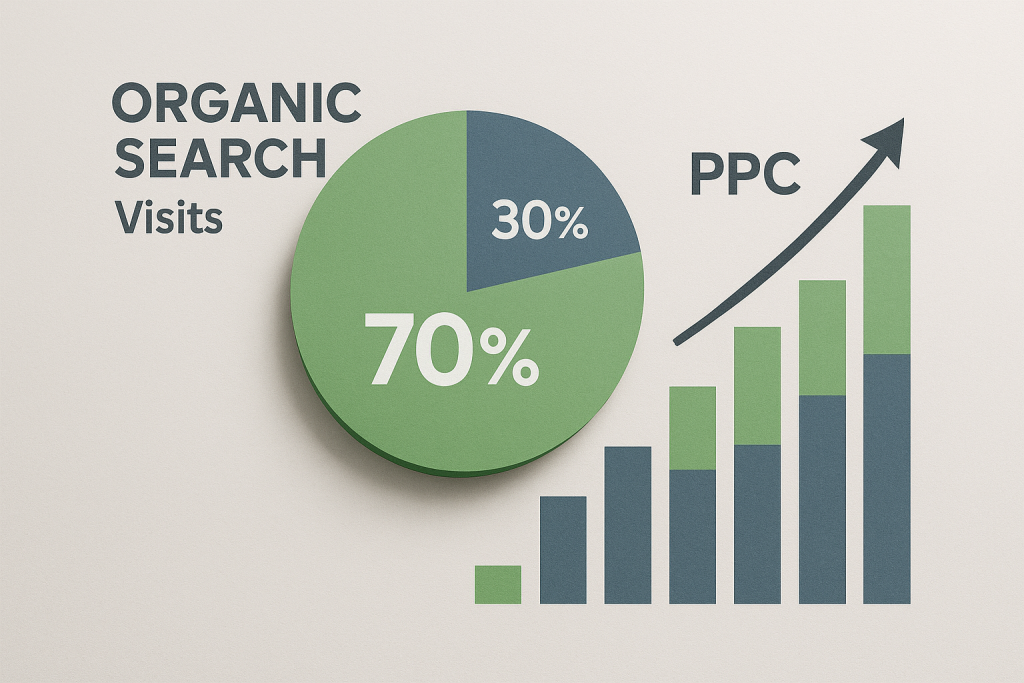
    In fact, organic search often delivers over half of website visits because 70% of users prefer “natural” results. PPC can fill in the gaps for competitive keywords or short-term promotions, while organic SEO builds a sustainable foundation for growth.

    4 Key Benefits of SEO Services

    1. Increased Visibility & Brand Awareness

    Ranking higher in search results puts your brand in front of new prospects. Top-ranking pages typically attract a much larger share of attention than lower positions, so reaching page one significantly improves visibility. SEO also allows you to target informational or “top-of-funnel” queries, for example, publishing blog content about industry topics. 

    This builds brand awareness without paying for every click and helps establish trust in your expertise.

    2. Qualified Traffic

    SEO attracts people who are actively searching for what you offer. By focusing on relevant keywords and long-tail phrases, you draw higher-quality leads – users closer to making a decision. Search engine optimisation “attracts qualified traffic” by matching content to user intent. 

    In short, SEO meets your target audience where they are searching, rather than casting a wide net at random.

    3. Long-Term ROI & Cost Efficiency

    Unlike ads, SEO content works over and over. A blog post or service page can rank for months or years, generating free visits long after it’s written. This compounding effect means leads from SEO often cost far less than paid leads. One analysis found companies engaging in SEO saved ~400% on equivalent ad spend while maintaining the same traffic. 

    In other words, every pound invested in SEO can yield a much higher return over time than the same pound spent on PPC.

    4. Better User Experience

    Good SEO demands a solid website. Google now prioritises mobile-friendly, fast-loading pages, so optimising for SEO automatically makes your site more user-friendly. A well-optimised site keeps visitors engaged (lower bounce rates) and makes it easier for them to convert. 

    In effect, SEO is about giving users the experience they want – something Google rewards with higher rankings.

    Measuring ROI: When Will You See Results?

    SEO is not an instant fix, but it is measurable. Search engine ads (PPC) give immediate data (cost-per-click and conversions), whereas organic SEO ROI needs attribution via analytics. Still, many businesses find that after the initial ramp-up, organic channels outperform paid ones.

    Many organisations continue to invest in SEO as a core part of their marketing mix, reflecting confidence in its long-term impact. With the right analytics and attribution in place, businesses can connect organic search traffic to leads and sales, making SEO’s value measurable over time.

    That said, be prepared to wait: SEO often takes 6-12 months to show significant impact. It takes time for Google to index and rank new pages, and to outrank established competitors. But once you reach a steady rank, the traffic tends to keep coming. Think of SEO as a marathon, not a sprint. Over the long run, consistent SEO effort typically delivers a higher ROI than one-off campaigns.

    Are SEO Companies Worth It?

    For most mid-sized or larger businesses, hiring an SEO agency is worth it – provided you choose the right partner. Cheap “quick fix” services usually disappoint; for example, organisations spending under $500/month on SEO are far more likely to be unhappy with the results. Instead, look for expertise and a clear strategy. As one source bluntly states, “So, are SEO companies worth it? Yes, if you go for quality.”

    At Seek Marketing Partners, we focus on quality from day one. We start with a thorough audit and audience research to ensure our efforts target what your customers really need. We then create technical and content strategies to drive results for your specific goals. The result is an SEO plan that converts traffic into sales – exactly what our data-led process promises.

    Ready to See How SEO and Paid Search Can Work for Your Organisation?

    Get in touch to book a consultation with our experts today. We’ll show you how a tailored SEO strategy can boost your visibility and ROI. For now, remember this: SEO services are worth it when done right. With a strong strategy and the right agency, organic and paid search will become reliable channels for growth.

  • 9 Non-Obvious SEO Advice for Startups in 2026

    9 Non-Obvious SEO Advice for Startups in 2026

    Many SEO guides cover the basics like submitting a sitemap, thinking about search intent, using keywords, adding infographics, and writing enriched meta descriptions, but startups need deeper insights beyond “table-stakes” tips. In 2026, SEO isn’t just about optimising for Google; it’s about being discoverable wherever your audience seeks answers. This non-obvious SEO advice can give startups and small businesses a competitive edge.

    Experts’ SEO Advice to Maintain Visibility Online

    1. Optimise for Search Everywhere, Not Just Google

    Search habits are shifting. People search via TikTok, YouTube, AI chatbots, forums, and more – not only Google. As Shelley Walsh notes, one expert slogan is “search everywhere optimisation,” reflecting the need to appear on any platform your audience uses. 

    2026 SEO means creating content that algorithms can easily index and serve in any context. In practice, that means publishing content and profiles on multiple channels and engaging in niche communities – not relying solely on Google rankings.

    2. Prepare for AI & Voice Search Integration

    Voice assistants and AI search are booming. In 2025, roughly 20.5% of people globally use voice search, with over 8.4 billion voice-enabled devices in use. Startups should optimise content to be found by digital assistants (think smart speakers and chatbots). This includes using natural language keywords, focusing on question-and-answer content, and ensuring pages load fast for voice queries. 

    Essentially, make sure your answers to common questions are structured so Siri, Alexa, or ChatGPT can extract and present them. Ignoring AI search would be a missed opportunity – one expert reminds us that SEO isn’t dead just because LLMs exist; Google remains a dominant discovery channel alongside emerging AI tools.

    3. Leverage Structured Data (Schema) Everywhere

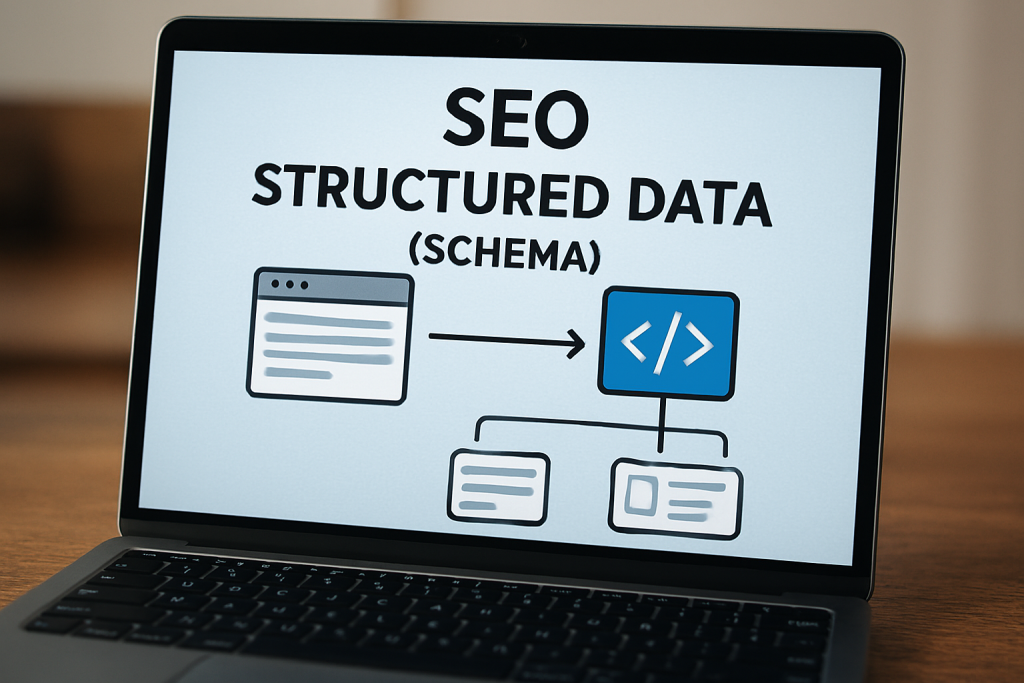
    Structured data is no longer optional. Google and other AI systems rely on schema to understand content context and generate rich results. Using JSON-LD markup for products, articles, events, and other entities can earn your startup a place in featured snippets, knowledge panels, and AI overviews. 

    According to Search Engine Land, structured data is an “essential part” of SEO strategy in 2025. In short, add relevant schema tags to highlight critical information like product specs, pricing, author details, FAQs, etc., so that AI “agents” and search engines can pull your content into voice answers and rich cards.

    4. Solve Your Target Users’ Real Problems

    Skip generic how-to guides. Instead, build content around the specific problems your audience is actually facing. As one startup SEO lead explains, “small SEO wins” come from content that solves real user problems. For example, publish tutorials, troubleshooting guides, or integration tips that address niche issues (e.g., “how to integrate our tool with X” or “best workflow using Y and our product”). Such problem-focused pages naturally rank for long-tail queries and help convert users.

    In fact, content meant for user help often becomes high-intent SEO collateral without being written for Google. Talk to your users, find their pain points, and create thorough answers – it’s both good UX and good SEO.

    5. Target Low-Volume, High-Intent Keywords

    Rather than fighting for broad keywords, lock down many narrow, low-competition terms. Early-stage companies benefit by ranking for dozens of niche queries (each with small search volume) rather than none of the big ones. For example, a tutorial for “analytics for Electron apps” that has 30 searches per month might only bring ~2,000 visitors a year, but 100 such pages means hundreds of thousands of targeted visitors.

    Use simple tools to identify long-tail questions, then answer them deeply. Over time, this builds your domain authority and paves the way for more competitive terms.

    6. Employ Defensive SEO Tactics

    Protect your niche by preemptively owning important topics. Write comparison and integration articles for your product or industry so competitors can’t easily rank there first. Examples include “YourProduct vs [Competitor]” or “How to connect YourProduct with PopularTool.” These pages serve as both user guides and sales collateral. 

    They are high-intent (the reader is already considering solutions), and even if they don’t buy immediately, they spread awareness. As one startup marketer advises, do this early, so competitors don’t swoop in first. Focus on how your solution is different, not just claiming superiority. Over time, these strategic pages can become some of your most valuable organic entry points.

    7. Focus on Quality and Authority, Not Quantity

    With AI-generated content flooding the web, authentic expertise and trustworthiness matter more than sheer output. Emphasise authoritativeness (experience or E-E-A-T): get industry mentions and reviews, and produce genuinely expert content. Don’t over-invest in endless thin blog posts. Instead, craft in-depth resources that only a real subject-matter expert could create. These will earn citations and user trust, which AI systems tend to favour when compiling answers.

    Expert Tip: Focus on the quality and conversion potential of content over the quantity, because bulk content can hurt your SEO over time.

    8. Measure Impact and Continuously Adapt

    Align SEO metrics to real business goals. Don’t get lost chasing vanity metrics; focus on what drives revenue from organic traffic. Regularly review which keywords and content formats truly convert. Embed learning into your workflow: use first-party data and analytics to prioritise topics that engage your audience. 

    This may mean tweaking strategies often as both the market and search algorithms evolve. In short, stay agile: audit your site’s technical health and content structure, keep improving what works, and don’t cling to outdated tactics.

    9. Leverage Niche Channels and Community Presence

    Finally, build visibility where your audience is, beyond search engines. Engage in industry forums, social networks, and Q&A sites. 

    Be active on relevant Subreddits, Quora threads, LinkedIn groups, or even Discord communities. Participating in these channels isn’t about keyword-optimising a page, but about shaping brand authority and earning backlinks or mentions. 

    These signals help AI and search systems “trust” your brand. In practice, this means sharing knowledge freely (and citing your site as a resource), so that when AI chatbots synthesise answers, they cite you.

    Note: Visibility in 2026 comes from “being mentioned in the right places” – authoritative publications, review sites, and community discussions.

    The Bottom Line

    Startups implementing these SEO optimisation tips can gain a competitive edge in 2026. Seek Marketing Partners specialises in global SEO services, helping small businesses and startups improve visibility. 

    For personalised guidance on these strategies, check our services or contact our SEO consultants for expert advice.

  • Guide to Pay Per Click for Lawyers: Driving High-Value Leads

    Guide to Pay Per Click for Lawyers: Driving High-Value Leads

    Pay per click for lawyers can be one of the fastest ways to generate new case enquiries. It can also be one of the quickest ways to burn through the budget if it’s handled poorly.

    Legal PPC sits at the sharp end of digital marketing. Costs are high. Competition is aggressive. And every click that turns into a low-quality enquiry has a real commercial impact. Law firms don’t need more traffic for the sake of it. They need relevant prospects in the right locations, with genuine intent to instruct.

    When PPC works, it delivers a more predictable pipeline and clearer ROI. When it doesn’t, firms are left questioning whether paid search is worth the investment at all. The difference is rarely the channel. It’s the strategy behind it.

    Why Pay Per Click for Lawyers Is So Competitive

    Legal search terms attract some of the highest-intent users online. When someone searches for a solicitor, a lawyer, or a specific legal service, they’re rarely browsing. They’re usually facing a problem that needs professional help.

    That intent drives up competition. Multiple firms are bidding on the same terms, often within tight geographic areas, and the cost per click reflects that pressure. In this environment, volume-based strategies fall apart quickly. Chasing clicks without understanding intent, location, and practice area relevance is a fast route to wasted spend.

    Pay per click for lawyers only works when campaigns are built around commercial reality, not generic PPC best practice.

    See how our industry-specific experience shapes PPC strategies across regulated and competitive sectors on our industries page.

    Why Generic PPC Advertising for Lawyers Underperforms

    Many law firms struggle with paid search because they’re using PPC strategies designed for lower-risk industries. Legal advertising has its own challenges, and generic approaches don’t translate well. Common causes of underperformance include:

    Broad keyword targeting: Attracts irrelevant searches that waste budget and dilute lead quality.Single campaign structures: Attempts to cover multiple practice areas in one campaign, reducing relevance and control.
    Weak location control: Allows ads to show outside viable service areas, especially for multi-office firms.Limited lead visibility: Provides little insight into which enquiries turn into viable cases.

    In PPC advertising for lawyers, success depends on filtering demand, not maximising it. The goal is to reach fewer people, but the right ones.

    What High-Performing PPC Campaigns for Law Firms Do Differently

    The strongest legal PPC campaigns share a few consistent traits. They are structured by practice area, not convenience. Each service has its own keywords, ads, and landing pages, aligned to the specific intent behind that search. Messaging is clear, compliant, and focused on credibility rather than gimmicks.

    Location targeting is handled with precision. Ads appear where the firm can realistically service enquiries, and budgets are allocated based on opportunity, not guesswork. Just as importantly, conversion paths are built for legal decision-making.

    Landing pages answer key trust questions quickly and make it easy for prospects to take the next step without friction. This is where PPC for lawyers becomes a performance channel rather than an experiment.

    If you want to see how this approach is applied in practice, explore our pay-per-click services and how we structure campaigns for measurable legal growth.

    The Most Expensive PPC Mistakes Law Firms Keep Making

    Legal PPC doesn’t fail quietly. When it goes wrong, it goes wrong at scale.

    Some of the most common and costly mistakes include:

    • Over-reliance on broad match keywords
    • Sending paid traffic to generic service pages
    • No call tracking or form attribution
    • Treating every enquiry as equal, regardless of quality
    • Optimising campaigns without feedback from intake teams

    Without clear visibility into which leads become genuine cases, firms end up optimising in the dark. Clicks go up, costs rise, and confidence drops.

    Our Approach to PPC for Lawyers at Seek Marketing Partners

    At Seek Marketing Partners, we treat legal PPC as a commercial system, not a traffic source.

    Every campaign starts with strategy. We define which practice areas matter most, where demand exists, and what a qualified enquiry actually looks like. Campaigns are then built around those realities, with structure, messaging, and budgets aligned to business priorities.

    Analytics plays a central role. We track beyond surface-level conversions to understand lead quality and performance trends over time. This allows us to optimise based on outcomes, not assumptions, and to give law firms clarity on where their spend is delivering value. Our work in PPC for lawyers is designed to support growth decisions, not just generate activity.

    For firms looking to support PPC with consistent brand visibility and demand generation, our social media marketing services help reinforce trust and extend reach beyond search.

    What Results Should Law Firms Expect From PPC?

    PPC is not a switch you flip and forget. Early performance often focuses on data gathering and refinement before efficiency improves.

    Well-run campaigns should deliver:

    • Consistent, high-intent enquiries
    • Clear visibility into cost per lead and cost per case
    • Measurable improvement over time through optimisation

    The firms that see the strongest results are those that view PPC as an ongoing performance channel rather than a short-term fix.

    Is Pay Per Click Right for Your Firm?

    Before investing in pay per click for lawyers, firms should ask a few practical questions.

    • Do you have clear service priorities, with defined practice areas you actively want to grow?
    • Is your geographic coverage clearly defined, so ads only appear where you can realistically service enquiries?
    • Do you have the internal capacity to handle, qualify, and follow up on leads quickly and consistently?
    • Are you prepared to invest in quality over volume, rather than chasing cheap clicks?

    If the answer to most of these is yes, PPC can be a strong growth channel. For firms without those foundations, it can still play a role, but it needs to be approached carefully and strategically.

    Get a PPC Consultation Built for Law Firms

    Legal PPC is too competitive to leave to guesswork. If you want clarity on whether paid search can deliver profitable growth for your firm, we can help.

    Seek Marketing Partners works with law firms that need control, transparency, and measurable outcomes from their marketing. If that sounds like what you’re looking for, speak to our team

  • Website Speed: Why Performance Is a Competitive Advantage

    Website Speed: Why Performance Is a Competitive Advantage

    If your website looks good but struggles to convert, hold rankings, or justify marketing spend, website speed is often the silent problem no one wants to own. It’s easy to treat performance as a technical detail. In reality, it’s a commercial issue that directly affects visibility, user behaviour, and revenue.

    Fast-loading sites don’t just “feel better”. They rank more consistently, convert more reliably, and waste less budget across SEO and paid media. Slow sites leak opportunity at every stage of the funnel, often without obvious warning signs.

    This guide breaks down what website speed actually means, why it matters for search and conversions, and how organisations should approach performance improvement properly, not with surface-level fixes.

    What Website Speed Really Means (And What Google Cares About)

    Website speed is not just “how fast a page loads”. It’s how quickly users can see, interact with, and trust your site.

    Google now measures this through Core Web Vitals, which focus on real user experience rather than theoretical load times:

    These metrics exist for one reason: slow, unstable, or unresponsive pages create poor user experiences. Google’s job is to rank results that satisfy users. Speed is no longer optional background hygiene – it’s part of how quality is judged.

    How Important Is Page Speed for SEO?

    Page speed is highly important for SEO, but it doesn’t work in isolation. To understand how important page speed is for SEO, it’s useful to look at how Google actually applies it. While page speed is a recognised ranking factor, its real impact comes from the way it amplifies or restricts the effectiveness of everything else on a site. 

    In competitive search results, faster pages are more likely to win when relevance is equal. Slow pages reduce crawl efficiency on large sites, increase bounce rates, and weaken engagement signals, while even strong content can underperform if it’s delivered slowly. 

    Page speed rarely causes sudden ranking drops on its own; instead, it quietly caps SEO performance, which is why many organisations invest heavily in content and links yet struggle to see proportional gains.

    If your website is slow and limiting your search visibility, our SEO services focus on removing performance bottlenecks that hold rankings and conversions back.

    The Commercial Impact of Website Speed

    The most overlooked aspect of website speed is its direct impact on revenue. Slow pages:

    • Increase bounce rates on landing pages
    • Reduce form completions and checkouts
    • Inflate cost per acquisition in paid campaigns
    • Undermine trust for first-time visitors

    For organisations running paid search, paid social, or large-scale SEO campaigns, speed issues compound quickly. You’re paying to drive users to pages that are less likely to convert. At scale – across multiple locations, services, or product lines – small performance issues turn into measurable commercial losses.

    Our web development services address website performance issues at the structural level, ensuring improvements translate into measurable gains in conversion and revenue.

    Measuring Website Speed: Tools vs Reality

    Most teams assess website performance using industry-standard testing tools. These platforms are useful for diagnostics, but they don’t tell the full performance story on their own.

    What Speed Testing Tools Do WellWhere They Fall Short
    Test pages in controlled environmentsDon’t reflect real-world user behaviour across devices
    Identify technical issues and errorsDon’t show how speed affects conversion paths
    Provide optimisation recommendationsDon’t prioritise fixes based on business impact
    Offer benchmark-style performance scoresCan overemphasise scores over outcomes

    In practice, effective website speed optimisation combines lab-based testing with real user data, analytics, and page-level performance insights tied directly to SEO, engagement, and conversion outcomes.

    What Actually Slows Websites Down

    Website performance issues are rarely caused by a single factor. More often, they stem from a combination of overloaded CMS themes and plugins, underpowered or poorly configured hosting, unoptimised images, fonts, and scripts, and an accumulation of third-party tools such as tracking, chat, and advertising platforms. 

    For larger sites, legacy templates rolled out at scale can quietly replicate performance problems across hundreds of pages. This is why quick fixes so often fall short. Treating individual symptoms, like compressing images, won’t resolve performance issues if the underlying site architecture or hosting environment remains the real bottleneck.

    Performance issues often reveal themselves in how users behave on key pages. Conversion rate optimisation helps identify where speed-related friction disrupts journeys and reduces completion.

    How to Increase Web Page Speed the Right Way

    If you’re serious about learning how to increase web page speed, the key is prioritisation. Effective optimisation focuses on:

    • Front-end efficiency (rendering, assets, scripts)
    • Server response times and hosting quality
    • CMS and platform configuration
    • Reducing unnecessary third-party dependencies
    • Continuous monitoring, not one-off fixes

    The goal is not a perfect speed score. It’s a consistent, measurable improvement where it matters most: high-traffic and high-conversion pages.

    Website Speed at Scale: Multi-Site and Enterprise Challenges

    For larger organisations, website speed challenges are rarely isolated. Shared templates deployed across hundreds of pages, multiple stakeholders making changes, and legacy technical decisions that are difficult to unwind can all contribute to performance issues being replicated across locations or brands. 

    At this level, website performance becomes a governance issue rather than a simple technical task. Sustainable performance requires clear standards, ongoing monitoring, and accountability, supported by analytics that link speed improvements directly to measurable business results.

    When Website Speed Becomes a Performance Bottleneck

    Speed is actively holding performance back when:

    • SEO improvements stall despite good content and links
    • Paid campaigns struggle to convert
    • Bounce rates remain high on priority pages
    • Mobile performance lags behind desktop

    This is usually the point where DIY optimisation stops delivering value. A structured performance audit can identify where speed is limiting growth and what fixes will actually move the needle.

    Website Speed Is a Strategic Advantage

    Website speed is no longer a background technical concern. It’s a competitive advantage that affects search visibility, user trust, and conversion performance. Fast sites don’t just rank better. They perform better. Organisations that treat speed as an ongoing performance discipline, not a checklist, gain more value from every marketing channel they invest in.

    Get a Website Speed & Performance Consultation

    If your site traffic isn’t converting as it should, or your SEO performance feels capped, speed may be the constraint you haven’t addressed properly.

    Seek Marketing Partners delivers data-led website speed audits focused on real outcomes and not vanity scores. We identify what’s slowing performance, prioritise fixes based on impact, and tie improvements directly to growth.

  • What Is Generative Engine Optimisation? Why It Matters Now

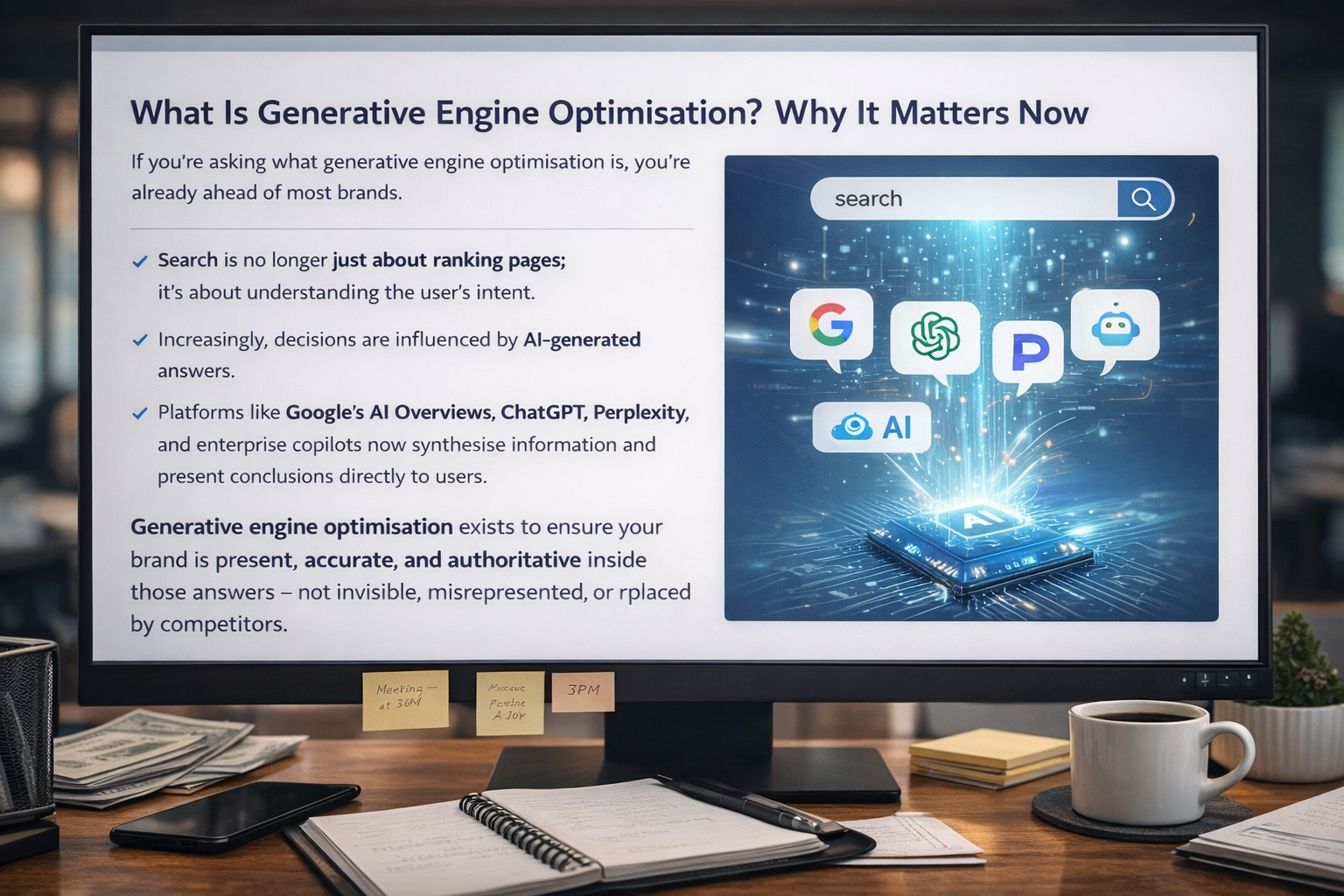
    What Is Generative Engine Optimisation? Why It Matters Now

    If you’re asking what generative engine optimisation is, you’re already ahead of most brands.

    Search is no longer just about ranking pages; it’s about understanding the user’s intent. Increasingly, decisions are influenced by AI-generated answers. Platforms like Google’s AI Overviews, ChatGPT, Perplexity, and enterprise copilots now synthesise information and present conclusions directly to users.

    Generative engine optimisation exists to ensure your brand is present, accurate, and authoritative inside those answers – not invisible, misrepresented, or replaced by competitors.

    What Is Generative Engine Optimisation?

    So, what is generative engine optimisation? It’s the practice of structuring content so AI systems can accurately interpret, trust, and cite it – not just ranked by traditional search algorithms. 

    Rather than competing for blue-link positions, GEO focuses on being cited in AI-generated responses, shaping how brands, products, and expertise are summarised, and ensuring accuracy when AI interprets complex topics. In short, it’s about influence, not just visibility.

    How GEO Actually Works

    Generative engines don’t “rank” content in the traditional sense. They interpret, compare, and synthesise information from multiple sources to construct an answer.

    Effective GEO aligns content with how these systems evaluate trust and relevance, including:

    • Clear entity definitions and consistent terminology
    • Structured explanations that answer real questions directly
    • Contextual depth rather than surface-level keyword usage
    • Signals of authority, accuracy, and corroboration

    Content that performs well here isn’t clever or promotional. It’s clear, structured, and difficult to misinterpret.

    GEO builds on the same foundations as strong SEO, so if you want to strengthen how your content performs across both traditional search and AI-driven discovery, our search engine optimisation services provide the strategic base to do it properly.

    GEO vs Traditional SEO

    Traditional SEO is still important, but it’s no longer sufficient on its own. Ranking pages and driving clicks remains valuable, yet it doesn’t fully reflect how people now discover, evaluate, and choose solutions in AI-driven search environments.

    SEO focuses on improving page visibility through keywords, links, and technical signals, with success measured in traffic and rankings. It’s designed for a model where users compare results and decide what to click, making it effective for discovery and demand capture.

    Generative engine optimisation addresses what happens next. GEO focuses on influencing AI-generated answers by optimising for entities, concepts, and clarity rather than rankings alone. It doesn’t replace SEO. Instead, it extends it into environments where decisions are increasingly being made.

    Where GEO Shows Up Today

    You’re already seeing the effects, whether you planned for it or not. Generative engine optimisation influences visibility in:

    • Google AI Overviews
    • ChatGPT and Copilot-style assistants
    • Perplexity and answer-first search tools
    • Internal AI search tools used by enterprises

    In many cases, users never click through to a website. Yet opinions are formed, vendors are shortlisted, and brands are either trusted or ignored.

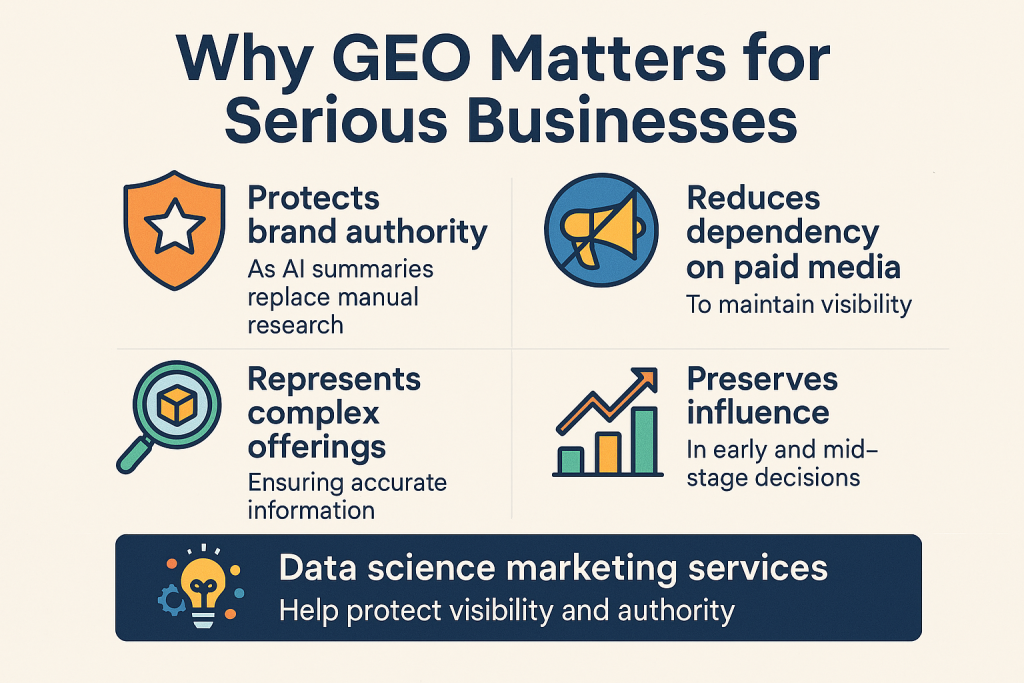
    Why GEO Matters for Serious Businesses

    For multi-site brands and established organisations, this shift is commercial and not theoretical. GEO helps protect brand authority as AI summaries replace manual research, reduces dependency on paid media to maintain visibility, and ensures complex offerings are represented accurately. 

    It also preserves influence during early- and mid-stage decision-making, where perceptions are formed long before a click occurs. If your competitors shape the narrative and you don’t, AI systems will still provide answers – just not in your favour.

    Because GEO relies on accurate data, measurement, and interpretation at scale, our data science marketing services help brands understand how they’re being represented and make informed decisions to protect visibility and authority.

    What Effective GEO Involves

    Strategic content architecture: Content is structured across topics and entities to support authority and consistency, not scattered across disconnected blog posts.Answer-led structuring: Pages are designed to deliver clear, synthesised answers that AI systems can easily interpret, reference, and reuse.
    Visibility and representation analytics: Performance is measured by how often and how accurately a brand appears within AI-generated responses, not just traffic metrics.Continuous optimisation: Content is refined as generative models, prompts, and user behaviours change, ensuring relevance over time.

    Why Most Brands Will Need a Generative Engine Optimisation Agency

    Many organisations underestimate how technical and high-risk this space is. Without specialist oversight, AI models can misinterpret brand positioning, inaccurate summaries can persist at scale, and competitors can dominate answers without outranking you.

    A dedicated generative engine optimisation agency brings the data, structure, and governance needed to manage this properly – especially for brands operating across multiple markets, products, or locations.

    For agencies and in-house teams that need additional expertise or execution capacity, our white-label digital marketing services provide specialist support to deliver GEO at scale, without compromising accuracy or control.

    How We Approach GEO

    At Seek Marketing Partners, we don’t treat GEO as a trend or an add-on. Our focus is on what generative optimisation actually is in practice: a disciplined, data-led approach to shaping how AI systems understand and represent your brand.

    Analytics-led execution: Decisions are driven by data on visibility, citation, and representation, not assumptions or generic best practices.Built for scale and complexity: Our approach is designed for organisations with multiple offerings, locations, or markets where precision and consistency matter.
    Authority and visibility measurement: Success is measured by how often your brand appears, how it is referenced, and how accurately it is represented within AI-generated answers.Integrated search and content strategy: Generative optimisation is aligned with SEO, content, and wider digital strategy to ensure consistency across all discovery environments.

    We focus on outcomes: how your brand appears, how often it’s referenced, and how reliably it’s understood.

    Is Generative Engine Optimisation Replacing SEO?

    No, it’s not. But it’s redefining what optimisation actually means. SEO still drives discovery. GEO shapes interpretation and influence. Brands that rely solely on rankings will increasingly find themselves visible but unheard.

    Final Thought: Stop Guessing How AI Sees Your Brand

    Generative engines are already shaping perception, shortlists, and trust. The only question is whether your brand is actively optimised or passively interpreted.

    If you want clarity on how AI systems currently represent your business, and what needs to change, it’s time for a strategic conversation.

  • What Is Employee Generated Content? Complete Guide

    What Is Employee Generated Content? Complete Guide

    Employee generated content is becoming a core growth driver for mid-size and enterprise organisations – not because it’s trendy, but because it solves real performance problems. Buyers trust people more than brands, organic reach continues to decline, and organisations need credible voices that cut through crowded digital spaces. 

    Employee content does exactly that. It builds trust, extends reach, and strengthens the entire marketing ecosystem without adding unnecessary production costs or workflow bottlenecks.

    In this guide, you’ll find a clear definition of employee content, why it works, the measurable benefits it delivers, how leading organisations build their programmes, and the strategic and operational steps required to implement EGC at scale. 

    You’ll also see examples, governance considerations, enablement structures, and integration practices that transform EGC from “extra content” into a consistent, performance-driven channel.

    What Employee Generated Content Is and Why It Matters to Modern Organisations

    Employee generated content refers to content created by employees that shares their insight, experience, or expertise. In B2B, this includes thought-leadership posts, industry commentary, product explanations, event takeaways, and authentic culture stories.

    Unlike branded content, which is filtered through corporate messaging, EGC gives audiences direct access to the people behind the organisation. This builds trust, relevance, and credibility. Buying behaviours have also shifted – decision-makers want transparency and practitioner-level insight, not polished advertising. EGC delivers the authenticity and clarity they respond to most.

    As a result, organisations are investing more in structured programmes that support and scale employee content. When teams contribute meaningfully, the brand becomes more discoverable, more trusted, and more human.

    If you want to strengthen your organisation’s social presence and amplify employee content effectively, explore our Social Media Marketing Services.

    The Shift Toward Trusted Voices and Credible Content

    Trust is the currency of modern digital marketing, and audiences interpret credibility differently today. They want insight from specialists, clarity from practitioners, and proof from the people who manage, build, or deliver the product or service. This is where employee content outperforms traditional brand messaging.

    Audiences trust employees because:

    • They speak from direct experience.
    • They explain real challenges and real solutions.
    • They communicate in a natural, human tone.
    • They’re not bound by the polished language of corporate channels.

    This shift is especially visible on LinkedIn, where employee insight posts routinely outperform branded posts on impressions, reactions, comments, and click-through rates. The format is informal but informed, technical without being academic, and specific to the problems target audiences actively research.

    For organisations, this creates an opportunity to multiply reach and deepen trust without proportionally increasing production overhead. By enabling employees to share what they know, companies unlock an amplification layer that marketing teams cannot achieve alone.

    Measurable Business Benefits of Employee Generated Content

    Employee generated content isn’t just “nice to have.” It moves real metrics across awareness, engagement, pipeline contribution, recruitment, and brand perception. When implemented with structure and governance, EGC becomes a scalable performance channel.

    Here are the core business benefits:

    Stronger Brand Trust and Social Proof


    Audiences trust practitioners more than polished corporate messaging. When employees share expertise, real project experiences, and opinions on industry developments, it signals authority and transparency – two critical drivers of early-stage engagement and buyer confidence.

    Significantly Higher Organic Reach


    Even the strongest brand channels have limited reach compared to the collective influence of employees. Algorithms consistently reward content shared by individuals, which means employee posts naturally outperform branded assets.

    Better Engagement and Performance Metrics


    Employee content delivers higher interaction rates across all major social platforms. This translates to more impressions, more conversations, more time spent with the brand, and stronger awareness in key audience segments.

    Talent Attraction and Employer-Brand Visibility


    Authentic employee stories – career journeys, team culture, behind-the-scenes insights – help companies attract better applicants and improve perception among candidates. Content from real employees carries more weight than any employer-branding campaign.

    Tangible Impact on Pipeline and Revenue Influence

    High-performing organisations map EGC to measurable commercial outcomes. This includes lead quality improvements, increased landing-page activity, higher demo-request volumes following employee posts, and improved nurture performance across social funnels.

    These benefits align directly with how modern organisations measure marketing efficiency: trust, reach, engagement, and conversion influence.

    If you’re looking to strengthen brand visibility, credibility, and thought leadership alongside your EGC efforts, explore our Digital PR Services.

    Types of Employee Generated Content That Perform Best

    There are many ways employees contribute content, but certain formats consistently outperform others, particularly in B2B environments where expertise drives decision-making.

    High-performing formats include:

    • Short insight posts: Quick commentary on trends, challenges, or practical solutions builds credibility fast.
    • Project or experience takeaways: Highlighting lessons learned demonstrates depth and real-world problem-solving.
    • Short-form videos: Unpolished, clear explanations often outperform studio-produced brand videos.
    • Culture and team content: Helps build employer-brand trust and recruitment visibility.
    • Event recaps and learnings: Employees who attend conferences or industry events are ideal sources of timely, relevant content.

    Effective employee generated content examples cover a wide range of these formats, each offering unique ways to highlight expertise, authenticity, and the lived experiences that audiences increasingly rely on when evaluating brands.

    The key principle is consistency. Employees don’t need to post daily; they need to post meaningfully.

    How Organisations Use Employee Posts, Videos, and Thought Leadership Effectively

    Successful organisations don’t leave EGC to chance. They structure it. They enable it. They measure it. They treat it as an extension of their content and social strategy.

    Common approaches include:

    • Encouraging employees to share insights around specific campaigns or themes
    • Using EGC to amplify product launches, events, awards, or milestones
    • Integrating employee posts into nurture flows or content clusters
    • Repurposing top-performing posts into blogs, videos, or newsletters
    • Developing internal champions who model best practices

    Employee generated content examples from leading organisations usually reflect this structure, offering a mix of insight, culture, education, and brand-aligned storytelling. When done well, employee content becomes an always-on engine that builds awareness and reinforces credibility throughout the buyer journey.

    Strong design also plays a key role in elevating these employee stories and making them more engaging. If you need support creating on-brand visuals that enhance your EGC output, explore our Graphic Design Services.

    Employee Generated Content Strategy

    A strong EGC strategy aligns goals, governance, enablement, and measurement into a cohesive system. Without structure, participation becomes inconsistent, messaging becomes fragmented, and results become impossible to track. A reliable enterprise-level framework includes:

    1. Define Objectives and Success Metrics

    Start with clarity: what is the organisation trying to achieve with EGC? 

    Common objectives include:

    • Increasing reach and brand discoverability
    • Improving thought-leadership visibility
    • Strengthening employer-brand perception
    • Supporting recruitment campaigns
    • Influencing pipeline metrics or accelerating deal velocity

    KPIs should be measurable, realistic, and aligned with wider marketing objectives.

    2. Establish Governance and Guardrails

    Governance protects the organisation without restricting authenticity.

    This includes:

    • Confidentiality and compliance rules
    • Tone and messaging guidelines
    • Approved topics and no-go areas
    • Escalation paths for sensitive content

    Over-restrictive policies kill momentum. Overly loose policies introduce risk. The most effective programmes strike a balance.

    3. Equip Employees with Tools, Prompts, and Training

    Employees are more willing to contribute content when they know how and where to start.

    Enablement assets may include:

    • Writing prompts
    • Headline and post templates
    • Video structure guides
    • Platform best practices
    • Examples of high-performing formats

    Training should be practical, short, and focused on impact and not theory.

    4. Launch a Controlled Pilot and Scale Gradually

    Start with a small group of advocates, measure performance, refine guidelines, and expand. This approach improves content quality and encourages more employees to participate once they see real results.

    Setting Goals, Guidelines, and Governance

    Organisations that treat EGC as a structured programme, rather than an occasional initiative, see stronger and more predictable results. Goal-setting and governance ensure content aligns with company values, legal requirements, and brand positioning.

    Core governance components include:

    • Publishing guidelines
    • Confidentiality checks
    • Review workflows for specific content types
    • Policies on external commentary
    • Recommended posting frequencies
    • Brand-safe language guidelines

    Combine this with transparent measurement – reach, engagement, sentiment, traffic, assisted conversions – and EGC becomes a channel teams can actively optimise.

    Knowing what employee generated content is becomes an even more important question at this stage, because clarity around definition, purpose, and boundaries directly affects how employees participate and how confidently they show up online.

    Empowering Employees and Choosing the Right Platforms

    Employees create better content when they feel confident and supported. This is where practical enablement tools, ongoing training, and simple workflows make the biggest difference.

    Enablement practices include:

    • Monthly training clinics
    • Quick feedback loops
    • Recognition for top performers
    • Content libraries with pre-approved themes
    • Templates for posts, videos, and commentary

    LinkedIn is the primary platform for most B2B EGC programmes due to its professional focus and algorithmic preference for individual posts. Organisations may also use short-form video platforms where appropriate, but LinkedIn remains the most efficient channel for reach, credibility, and commercial influence.

    Understanding what employee generated content is within this context ensures employees know what matters, what resonates with audiences, and which formats align with brand objectives.

    If you want support developing a stronger content engine that works alongside your EGC efforts, explore our Content Marketing Services.

    Tools, Workflows, and Best Practices for Employee Content

    Scale requires process. Without operational workflows, organisations cannot maintain consistent output or track performance with accuracy.

    Essential components include:

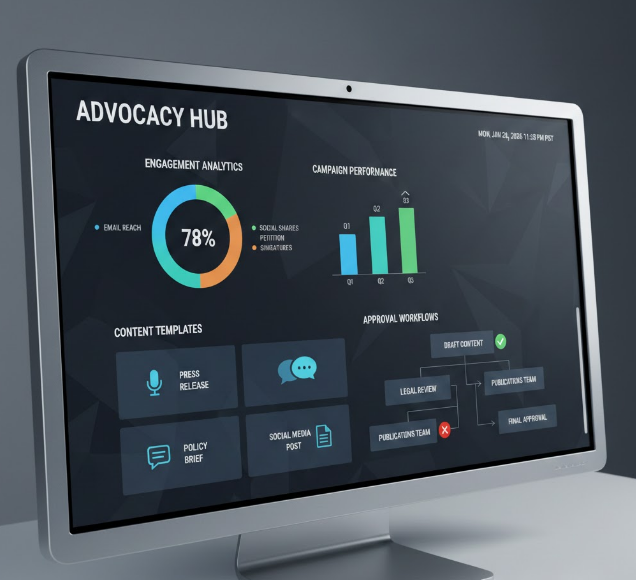
    • Advocacy tools for content distribution
    • Analytics platforms for performance tracking
    • Content management systems for storing prompts and templates
    • Lightweight approval workflows for sensitive posts
    • Reporting frameworks for cross-team visibility

    These tools streamline participation, protect brand integrity, and ensure EGC feeds into broader content and marketing strategies.

    How to Integrate EGC with Brand, Content, and Social Media Strategies

    EGC should never exist in isolation. It works best when integrated into the organisation’s content pillars, campaign themes, and social strategies.

    Key integration steps include:

    • Mapping employee content topics to brand pillars
    • Aligning employee posts with campaign calendars
    • Repurposing strong employee insights into long-form content
    • Using UTM parameters to track traffic and conversions
    • Reviewing monthly performance and scaling formats that deliver results

    Integration turns EGC from “employee participation” into a measurable, repeatable growth channel.

    To strengthen this integration and improve overall marketing performance, explore our Digital Marketing Services.

    Turning Employee Voices Into a Scalable Growth Channel

    Employee generated content is a strategic capability that strengthens trust, visibility, and commercial performance across the entire organisation. When employees share real insight and perspective, audiences respond with higher engagement, stronger trust, and clearer intent.

    But EGC only performs at scale when it is built on structure: defined goals, consistent governance, practical enablement, and measurement that feeds into wider marketing and brand strategies.

    High-performing organisations treat EGC as part of their operating system, not a short-term experiment. They equip employees with the tools and guidance to contribute confidently, integrate EGC into broader content pillars, and refine performance using real data.

    When you approach employee content with this level of intention, it becomes a dependable growth lever – one that builds authority, accelerates buying decisions, and humanises the brand in ways traditional marketing cannot match.

    If you’re ready to strengthen your organisation’s digital presence, reach out through our Contact Us page.

  • Keyword Stuffing: What It Is, Why It Fails & How to Avoid It

    Keyword Stuffing: What It Is, Why It Fails & How to Avoid It

    If you’re still worrying about hitting a “perfect” keyword percentage, you’re already heading in the wrong direction. Keyword stuffing is one of the fastest ways to undermine content quality, user trust, and search visibility and Google has been clear about that for years.

    Yet it still happens. Sometimes deliberately. Often accidentally.

    In this guide, we break down what keyword stuffing is, how Google detects it, why it damages performance, and what modern, compliant optimisation actually looks like. This isn’t theory – it’s grounded in Google’s spam policies, real-world SEO practice, and how search engines evaluate relevance today.

    What Is Keyword Stuffing?

    What is keyword stuffing? In simple terms, it’s the practice of overusing a keyword or phrase to the point where it harms readability and exists primarily to manipulate rankings rather than help users.

    From Google’s perspective, keyword overloading is a spam tactic. It includes forcing keywords into content unnaturally, grouping them into lists, or repeating phrases so often that the page no longer reads like something written for a human being.

    It’s important to note that keywords themselves aren’t the problem. Google still uses terms on a page to understand relevance. The issue arises when keywords are used excessively, out of context, or without informational value.

    Why Keyword Stuffing is a Problem in SEO

    Keyword stuffing in SEO fails for three fundamental reasons:

    1. It violates Google’s spam policies
    2. It degrades user experience
    3. It signals low-quality intent

    Modern search algorithms are designed to reward content that demonstrates understanding, relevance, and usefulness – not repetition. Pages that rely on keyword volume instead of substance tend to perform poorly once evaluated against real user signals.

    Google has explicitly stated that eligibility to appear in search results begins with not violating spam policies. This puts that eligibility at risk before rankings are even considered.

    If you want to ensure your content meets Google’s standards and drives real results, explore our Search Engine Optimisation services for expert guidance.

    Visible vs Hidden Keyword Stuffing

    Not all keyword stuffing looks the same. Broadly, it falls into two categories.

    Visible Keyword Stuffing

    This is the most obvious form. Users can see it immediately.

    Examples include:

    • Repeating the same phrase in every sentence
    • Awkward keyword-heavy paragraphs
    • Lists of locations, services, or phrases added purely to rank

    This type of content often reads poorly and damages brand perception almost instantly.

    Hidden Keyword Stuffing

    Hidden stuffing attempts to manipulate search engines without users noticing.

    According to Google, this includes:

    • White text on a white background
    • Text hidden behind images
    • CSS positioning that moves text off-screen
    • Font sizes or opacity set to zero
    • Links hidden behind a single character

    While some dynamic design elements are perfectly legitimate (accordions, tabs, sliders), deliberately concealing keywords for ranking purposes is a clear violation.

    How Google Detects Keyword Stuffing

    Google doesn’t rely on a single signal. Detection is based on patterns, not thresholds. Algorithms analyse:

    • keyword frequency relative to page length.
    • placement across titles, headings, body copy, anchors, and alt text.
    • repetition without contextual variation.
    • misalignment between query intent and page content.

    Updates such as Panda and Hummingbird shifted Google’s focus toward context, semantics, and intent, making mechanical keyword strategies ineffective. In other words, if content sounds unnatural to a human reader, it’s very likely to raise flags algorithmically.

    Protect your site from algorithmic penalties by leveraging our Technical SEO services to ensure content is both human-friendly and search-engine compliant.

    What Happens When Google Penalises Keyword Stuffing?

    The impact is rarely isolated to a single keyword or page. When Google detects spam-like optimisation patterns, the effects can spread across an entire site, suppressing rankings on multiple URLs and significantly reducing organic visibility. In more serious cases, manual actions may be applied, removing pages from search results altogether.

    Recovery is often slow and resource-intensive. Addressing spam-related issues typically involves extensive content rework, reindexing, and waiting for trust signals to rebuild. During this period, performance stagnates, budgets are diverted to fixes rather than growth, and long-term brand credibility can suffer.

    Why Keyword Stuffing Still Happens Today

    Despite years of guidance, keyword spamming persists for a few reasons:

    • Legacy SEO advice often focused heavily on meeting specific keyword density targets, leading writers to overuse keywords.
    • Some content creators misinterpret guidance to “include keywords,” taking it as a directive to insert them wherever possible.
    • There is an overreliance on outdated optimisation checklists, which fail to account for modern search engine algorithms and user experience.
    • Automated content generation tools can produce keyword-heavy text without sufficient editorial oversight, resulting in unnatural phrasing.

    It’s rarely malicious. More often, it’s the result of optimisation being treated as a mechanical task rather than a strategic one.

    Avoid common SEO pitfalls by working with our Content Marketing services to create naturally optimised, audience-first content.

    Modern SEO Best Practice on How to Avoid Keyword Stuffing

    Avoiding keyword spamming doesn’t mean ignoring keywords. It means using them correctly.

    Focus on One Primary Topic Per Page

    Each page should target:

    • One primary keyword
    • A small set of closely related secondary terms

    Trying to rank a single page for dozens of variations increases the risk of forced repetition and diluted intent.

    HiFollow On-Page Best Practices (Without Forcing It)

    Best practice still includes:

    • Using the primary keyword in the title, H1, and early body content
    • Supporting it with related phrases and concepts
    • Writing descriptive, human-readable headings

    What it does not include is aiming for a specific keyword density or repeating phrases simply to “reinforce” relevance.

    Semantic SEO, Entities, and Context

    Modern SEO is about meaning, not keyword counts. Search engines now understand synonyms, related concepts, entity relationships, and topical depth. 

    By covering a subject comprehensively and naturally, you signal relevance without overusing keywords. This is why well-structured, long-form content consistently outperforms shallow, keyword-heavy pages.

    Monitoring and Auditing Content Safely

    Optimisation doesn’t stop at publication. Regular audits help spot overused phrases, outdated optimisation patterns, and shifts in search intent.

    Tools like Google Search Console and professional SEO platforms can reveal keyword usage trends, but manual review still matters. Reading content aloud is one of the simplest ways to catch awkward phrasing before it impacts readability and performance.

    Optimise for Humans, Not Counters

    There are no shortcuts here.

    Keyword stuffing doesn’t work because search engines no longer reward it and users never did. Effective SEO is about clarity, intent, and usefulness. Keywords support that process; they don’t drive it.

    If optimisation decisions are guided by “does this help the reader understand the topic better?”, you’re on the right side of both Google’s guidelines and long-term performance. And if you’re unsure whether your content is crossing the line, that uncertainty alone is often a sign it needs a second look.

  • Seek Marketing Partners Goes to Patar Beach!

    Seek Marketing Partners Goes to Patar Beach!

    There’s something about road trips, karaoke nights, and shared meals that bring a team closer together. Earlier this year, the digital marketing team from Seek Marketing Partners packed their bags and headed to the coast for a much-needed getaway in Patar Beach, Pangasinan.

    With 2 nights and 1 full day of laughs, travel, games, and bonding, this trip was more than just a break – it was a reminder of how strong team culture fuels great work. Here’s a glimpse into the memories we made.

    Best Moments of Seek Marketing Partners’ Team in Patar Beach

    Cape Bolinao & Patar Arrival

    Our adventure began at the iconic Cape Bolinao Lighthouse, a picturesque spot overlooking the sea. There, we took photos and captured stunning aerial shots using Ken Sison’s high-end drone, which had a tense moment when a bird tried to attack it mid-flight! We all had a laugh, relieved it made it back safely.
    Before hitting the road again, we grabbed a few souvenirs to remember the moment. The drive to Patar Beach took hours, but with team jokes and laughter echoing in the van, the trip felt much shorter.

    When we finally reached our transient home near Patar Beach, everyone took a quick breather before diving into dinner prep. Our ever-reliable chef, Jerome, served up crowd favourites: Dinakdakan and Bicol Express. Meanwhile, the rest of the team cranked up the karaoke and poured a few rounds of Alfonso – a bonding tradition we all agreed had to be on the agenda.

    Hundred Islands Adventures

    We kicked off Day 2 with breakfast courtesy of Jerome, then headed to the Hundred Islands National Park. From the boat ride to the first island, excitement was in the air. We hopped from one scenic island to another, snapping photos and flying the drone once again to capture stunning views from above.

    Some of our braver teammates opted for helmet diving, enjoying the underwater scenery and posing for a few unforgettable photos. Our final island stop was made even more memorable by a fresh oyster (talaba) tasting offered by a local – salty, satisfying, and straight from the sea.

    Although the zipline was closed due to rain, no one felt short-changed. The entire experience was filled with shared moments, big laughs, and new memories for the books.

    Night Games and Goodbyes

    After arriving back at our transient house, Jerome once again whipped up dinner while the rest of the team prepared for our final night of games. From guessing games to team-based challenges, we ended the trip in classic Seek Marketing Partners style – fun, loud, and full of energy.

    The next morning, we packed up, shared warm goodbyes, and made sure everyone was safely on their way home. While en route, the team called Ms. Paula to let her know we were heading back – and to our delight, she and Dean Braiden suggested a quick meet-up at a nearby mall. There, they surprised us with a generous treat from Zark’s Burgers – the perfect send-off to cap a weekend full of memories.

    Conclusion

    For Seek Marketing Partners, this trip wasn’t just a beach escape — it was about deepening trust, sharing stories, and celebrating our wins together. These outings keep our digital marketing team connected beyond the screen.

    Here’s to more milestones, more adventures, and a team that keeps showing up — for the work and for each other. For more information about us, marketing tips and strategies, and read more stories like this one, feel free to explore our latest posts on our blog hub.

  • How to Get More Visibility and Rank Higher in Google Search

    How to Get More Visibility and Rank Higher in Google Search

    If you want to rank higher in Google, you need more than just a checklist. You need a coherent strategy that aligns with intent, proves expertise, and removes friction for users and crawlers. This guide breaks down proven tactics into clear, actionable steps you can use today.

    Why Ranking Higher in Google Still Matters, Even in the AI Era

    Google remains the front door to discovery. Features change and AI overviews evolve, but brands that answer queries clearly, quickly, and credibly win the click. When you improve page quality, shore up technical foundations, and earn authority, you raise website visibility on Google and compound results across every channel.

    What you’ll learn: How to research topics that matter, structure pages that satisfy, fix technical bottlenecks, build authority ethically, and track progress so you keep momentum. 

    Along the way, you’ll see where to place your effort to rank higher in Google for the terms that actually move revenue.

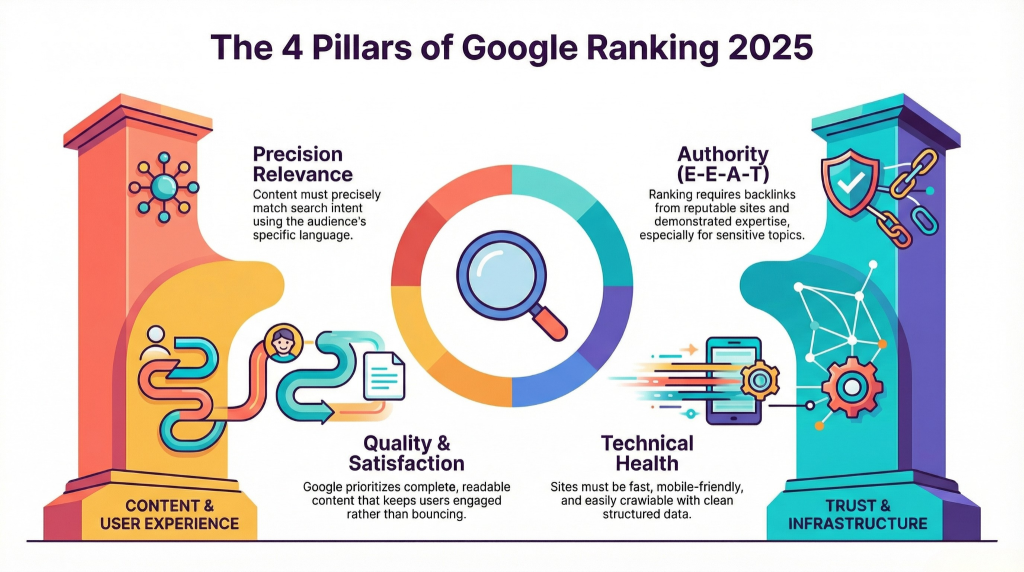
    Infographic illustrating four key Google Search ranking factors: precision, authority, quality, and technical health.

    Understand How Google Ranks Pages in 2025 and Beyond

    Google evaluates hundreds of signals, but four pillars drive outcomes:

    1. Relevance: Does your page precisely match the query and intent? That means a tight topic focus, helpful subtopics, and language your audience actually uses.
    2. Quality & satisfaction: Is the content complete, current, readable, and easy to skim? Do users stay, scroll, and act – or bounce to a competitor? The better the experience, the more likely you are to rank higher in Google for competitive terms.
    3. Authority: Do reputable sites reference or link to you? Demonstrating experience, expertise, authoritativeness, and trust (E-E-A-T) matters, especially for sensitive topics.

    Technical health: Fast, mobile-friendly, crawlable pages with clean internal links and structured data give algorithms confidence to surface your work and expand website visibility.

    Research Topics the Right Way

    Keyword tools are useful, but start with real voices – sales calls, support tickets, chat logs, and onsite search. Convert what you hear into seed topics, then use a tool to quantify demand and difficulty.

    Map intent before you draft

    Is the user looking to learn, compare, or act? If a query is informational, produce a guide; if it’s transactional, build a focused landing page. Aligning format to intent is one of the fastest ways to rank higher in Google because it reduces pogo sticking.

    Favour specificity

    Long-tail phrases reveal context and often convert better. Use them to improve keyword rankings for attainable opportunities while you build authority for broader terms.

    Cluster-related queries

    Group closely related phrases into a single page with clear subheadings, then interlink to deeper pieces. This signals topical depth and helps you rank higher in search engines like Google for the cluster, not just a single term.

    Ready to turn keyword research into real growth? Contact us and let our team help you uncover the topics that drive rankings, traffic, and revenue.
    Get a Digital Marketing Consultation

    Create Pages That Fully Satisfy Search Intent

    The fastest way to win in search is to give people exactly what they came for without the fluff. When your page answers questions clearly and quickly, engagement climbs and rankings follow.

    Lead with the answer

    Open with a clear, plain-English statement that addresses the query. Then expand with detail, examples, and evidence. This format increases eligibility for rich results and helps you rank higher in Google by satisfying intent quickly.

    Structure for skimming

    Use descriptive H2/H3s, short paragraphs, and visual cues such as tables or callouts. Add a table of contents on long pages. When readers can scan and find what they need, engagement climbs – and so do outcomes.

    Back it up with proof

    Cite sources, include real data, and add expert commentary. Demonstrating experience and authority is vital if you want to improve keyword rankings in competitive spaces.

    Write like a human

    Avoid keyword stuffing and corporate speak. Read the draft aloud. If it sounds helpful and natural, it’s doing its job. That’s how you quietly rank higher without tricks.

    Busy workspace with person analyzing data charts on a laptop and using sticky notes for brainstorming.

    Optimise Every Element That Impacts Rankings

    Small, focused changes to your on-page elements can create outsized gains in search performance. Nail these fundamentals, and you give both users and Google every reason to trust and rank your pages.

    Chat bubble icon with a hashtag symbol representing social media topics and conversations.

    Titles & meta descriptions

    Lead with the primary topic, promise a clear benefit, and keep titles within ~55-60 characters. Well-written snippets lift clicks, which helps pages rank higher in Google over time. Use meta descriptions to reinforce value and encourage action.

    Headings & first paragraph

    Use the target phrase once near the top, then rely on natural language and semantic variants. This helps improve the keyword rankings while keeping prose readable.

    Internal linking

    Treat internal links as routing instructions. Use descriptive anchors, link from high-authority pages, and surface related content hubs. Strong internal pathways expand website visibility on Google and distribute equity where it matters.

    Schema

    Add appropriate structured data (Article, FAQ, Product, LocalBusiness). Rich results can improve CTR and context, supporting your goal to rank higher in Google for target queries.

    Media & accessibility

    Optimise images, add alt text that describes the asset (not a string of keywords), and ensure colour contrast and focus states meet accessibility standards. Better UX gets better signals.
    Want your pages to work harder in search? Explore our SEO services and let us optimise every on-page element that drives rankings, traffic, and conversions.
    Learn More About Our SEO Services

    Build a Fast, Crawlable, High-Performing Site

    Even the best content won’t rank if your site gets in its own way. A fast, clean, crawlable website gives search engines confidence and keeps users from bouncing. Nail these fundamentals, and every other SEO effort works harder.

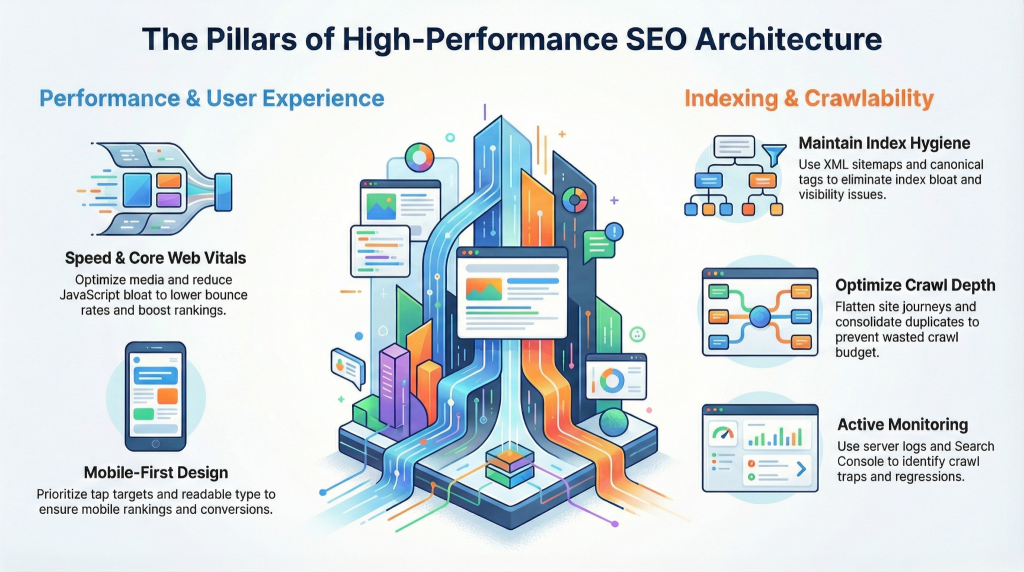
    Speed & Core Web Vitals

    Compress media, lazy-load below-the-fold assets, reduce JavaScript bloat, and serve static content via a CDN. Faster pages reduce bounce and help you rank higher in Google where competition is close.

    Mobile-first

    Design for tap targets, readable type, and simple navigation. If mobile UX suffers, rankings and conversions suffer with it.

    Index hygiene

    Create and submit XML sitemaps, fix soft 404s, remove index bloat, and use canonical tags properly. A clean index magnifies website visibility across your catalogue.

    Crawl depth & duplication

    Flatten key journeys, paginate correctly, and avoid thin near-duplicates. Consolidate where appropriate and redirect obsolete URLs to their best equivalents.

    Logs & monitoring

    Use server logs, Search Console, and analytics to spot crawl traps, redirect loops, and template regressions before they cost traffic.

    SEO architecture diagram outlining pillars for performance, user experience, and indexing.

    Build Real Authority That Lasts

    Chasing quick, spammy links doesn’t work – earning genuine trust does. By creating valuable assets and showing up where your audience already pays attention, you build authority that compounds over time.

    Publish link-worthy assets

    Original research, industry benchmarks, calculators, and well-designed explainers attract citations. Promote them through PR, newsletters, and relevant communities to rank higher in Google on head terms you couldn’t touch before.

    Earn mentions the right way

    Contribute expert quotes, join podcasts, and co-create with partners. Unlinked brand mentions also reinforce credibility and can help improve keyword rankings across related topics.

    Local signals (if applicable)

    Keep business details consistent, respond to reviews, and enrich your profiles with real photos and services. These signals support proximity-based visibility while your content earns broader authority.

    Ready to build real authority that drives lasting rankings? Contact us and let’s create assets and strategies that earn trust, and not just links.
    Get a Digital Marketing Consultation

    Network graph visualization with interconnected nodes representing data relationships.

    Build an Information Architecture That Grows With You

    A smart site structure doesn’t just organise content – it multiplies visibility. When users and search engines can navigate your pages effortlessly, rankings rise, engagement deepens, and every new piece of content works harder.

    Hubs and spokes

    Build comprehensive hub pages for core topics, then link to focused spokes that dive deeper into sub-themes. Clear hierarchies clarify relevance and help you rank higher in Google for whole clusters, not isolated phrases.

    Navigation that mirrors intent

    Group links by jobs-to-be-done, not org charts. If buyers compare, create comparison sections. If they evaluate pricing, make that path obvious.

    Consistency

    Reuse components and patterns so pages feel familiar. Predictable UX increases engagement, which supports stronger signals to improve keyword rankings across the site.

    Measure What Matters, Then Optimise With Purpose

    SEO isn’t “set and forget.” The brands that win are the ones that track what actually moves the needle, refine their approach, and double down on what works. Data turns guesswork into momentum.

    Define success up front

    Map KPIs to intent: engaged time for educational pieces, demo starts for product pages, or leads by segment. Tie these to commercial goals so efforts to rank higher in search align with revenue.

    Mine your data

    Use Search Console to find pages with high impressions but low CTR and rewrite titles/snippets. Identify queries where you sit 8-15 and strengthen those pages to nudge into the top results and expand website visibility on Google.

    Refresh content

    Update stats, add examples, answer new FAQs, and improve visuals. Freshness helps improve keyword rankings without starting from scratch.

    Test deliberately

    Pilot changes on a subset of pages, measure impact, then scale what works. Document wins and retires noise.

    Common Pitfalls to Avoid

    Chasing volume over intent: Big numbers don’t mean buyers. Prioritise terms that indicate action or qualified interest if you want to rank higher in Google and convert.
    Thin duplication: Copy-paste variants cannibalise each other. Consolidate, then build one excellent page instead of five weak ones.
    Vanity link building: Low-quality directories and paid link schemes risk penalties and rarely move the needle. Invest in assets people actually want to cite.
    Ignoring mobile: Most journeys start on phones. If your site feels cramped or sluggish, expect rankings and trust to decrease.

    Ready for Faster Gains?

    If you’re serious about growth, we can help you improve keyword rankings and expand website visibility on Google with a plan that fits your realities – budget, team and timelines.

    Get a Free SEO audit to pinpoint quick wins, or book a strategy call with our expert team today to map a quarter’s worth of priority pages. 

    Frequently Asked Questions

    How long does it take to see results?

    For existing sites, technical fixes and title/snippet improvements can move the needle in weeks. Competitive topics and authority building typically take a few months to show durable gains and improve keyword rankings.

    Do word counts still matter?

    Only insofar as they reflect completeness. Comprehensive, skimmable content beats verbose filler. Focus on satisfying intent; that’s what helps you rank higher in search engines, especially on Google reliably.

    Is the schema really worth the effort?

    Yes. It clarifies context, supports eligibility for rich results, and can lift CTR – collectively increasing website visibility on search engines like Google without changing your copy.

    What’s the best tool for research?

    Use the SERP first, then a reputable keyword platform. Cross-check with Search Console to validate what your audience actually uses.

  • Make Local Keywords Work for Your Digital Marketing Campaign

    Make Local Keywords Work for Your Digital Marketing Campaign

    If your customers search in towns, neighbourhoods and postcodes, your campaign should speak the same language. Using local keywords aligns your pages, ads and profiles with the way nearby buyers actually look for solutions. 

    Do this well, and you’ll raise visibility where it matters, attract high-intent visitors and turn more searches into enquiries, store visits and sales.

    What “Local” Actually Means and Why It Matters

    When someone goes online to ‘look for something’, they are also searching ‘where to find’ these. Sometimes the place is explicit: “solicitor in Guildford”, “Italian restaurant near me”. Other times, the location is implicit: “emergency plumber” or “estate agent” – where search engines automatically match the results based on the user’s location. 

    Both of these types of searches matter because buyers rarely add a town name when they’re in a hurry, but they still expect ‘nearby’ answers.

    Think of this as building relevance at street level. When your copy, titles and metadata include service areas, landmarks or neighbourhoods, you help search engines connect users to the right place at the right moment. That clarity improves click-through rates, reduces pogo sticking and sets stronger expectations before a visitor even lands on your site.

    In short, local keywords connect intent with place so your campaign shows up at the exact moment someone nearby needs you.

    Business Wins that Start with Local Keywords

    Greater local visibility

    Geographic signals help your pages qualify for local organic results and map listings. When your service and location are obvious, you stand a better chance of appearing in the pack that dominates the top of the results page for area-sensitive searches.

    Higher-intent traffic

    People searching close to the point of need behave differently from casual researchers. They want a phone number, a booking path, a directions button or a price. By aligning copy and calls to action with local context, you convert more visits into real outcomes.

    A durable competitive edge

    Many competitors target broad phrases and overlook places. Clear service-area pages, consistent business details and content that feels genuinely local make your brand more useful, and therefore more clickable, than a generic alternative down the road.

    Better economics

    A narrower geographic scope often reduces wasted ad spend. Whether you rely on organic reach or pair it with PPC, refining your themes around area and neighbourhood improves match quality, Quality Score and on-page conversion rates.

    Plan for Both: ‘Near Me’ and Generic Local Queries

    It’s easy to optimise only for terms that mention a town, county or “near me”. That’s just half the picture. Treat generic service queries with the same care, so search engines will still personalise results locally. Your structure should include these strategies:

    • Create service pages that stand on their own for generic queries (e.g., “boiler repair”) and demonstrate expertise.
    • Create location variants of those services for the areas you serve (e.g., “boiler repair in Reading”) with unique value – local testimonials, coverage hours and micro-copy about neighbourhood specifics.

    You earn relevance for both implicit and explicit discovery, rather than cannibalising your own pages.

    How to Find the Right Local Keywords

    Finding the right local keywords starts with listening to your customers, then layering data and structure to build pages that rank where it matters.

    1. Listen to customer language. Review call transcripts, chat logs, and emails to capture the real phrases and place names people use.
    2. Expand your list with local keyword research. Use trusted tools and filter by city, postcode, or region to see demand, difficulty, and intent.
    3. Build a simple service × area matrix. Map each service to real service areas and prioritise high-value opportunities.
    4. Add neighbourhood and landmark signals. Include districts, retail parks, and other wayfinding cues to surface long-tail location based keywords.
    5. Audit local competitors. Check their titles and headings to spot coverage gaps you can own.
    6. Group keywords by intent. Cluster related terms so each page targets a single, strong topic.
    7. Refresh quarterly. Revisit your keyword list to reflect seasonality, expansion, and changing demand.
    8. Weave keywords in naturally. Place them in titles, headings, FAQs, and alt text without forced repetition.

    This simple, structured process turns scattered ideas into a clear local keyword strategy that scales with your campaigns and keeps your visibility sharp.

    Strategic Places to Use Local Keywords

    On your website

    Give each core service a strong, generic page that can rank anywhere. Then add unique, well-crafted location pages for the areas you genuinely serve. Insert area names naturally in title tags, headings, opening paragraphs and image alt texts. Reference landmarks, service areas, or parking details to prove real presence. This is where local keywords carry the most weight – but keep copy human; search engines can detect boilerplate.

    In your content marketing

    Publish helpful pieces that speak to local needs: moving guides by borough, seasonal maintenance checklists by region, or “best of” resources that showcase knowledge of the area. These posts are excellent homes for location based keywords and internal links back to your service pages.

    On Google Business Profile

    Ensure your Google Business Profile (GBP) includes your business name, category and description, which should align with your primary services and areas. Use posts to announce local offers, add photos that reflect real premises or teams, and collect reviews that mention neighbourhoods organically. The more consistent your signals across profiles and citations, the easier it is for algorithms to trust where you are and what you do.

    In paid campaigns

    Mirror your organic structure in PPC. Use geo-targets and city-specific ad groups with matching copy. Send clicks to the most relevant page, not just the homepage, and align extensions (call, location, structured snippets) to the area. People searching locally want speed, so you should remove every extra step between intent and action as much as possible.

    In social and email

    When campaigns reference local events, partners or community highlights, engagement rises. Segment newsletters by region and tailor subject lines, offers and send times accordingly. Consistent place cues reinforce relevance in feeds and inboxes.
    Want to take this further? View all our services and build a campaign that wins local search.
    Our Digital Marketing Services

    How to Structure Location Pages Without Duplication

    Think in hubs and spokes. The hub is a comprehensive service page that covers the generic query thoroughly. The spokes are location pages that adapt the service for each area, with unique proof and content. 

    Link spokes back to the hub and across nearby areas where journeys overlap. This structure prevents thin duplication and makes crawling more efficient.

    For multi-site or franchise operations, define a naming convention, meta patterns and a component library upfront so editors can ship fast while maintaining quality. Governance matters, so templated content should be the starting point, not the final output. 

    Adding real local details gives your keywords a richer, more authentic context, and turns those visits into conversions.

    Key On-Page Elements for Strong Local SEO

    Titles and H1s: Put the service and place where users expect it, and avoid awkward separators or overly long strings.

    Opening paragraphs: Explain what you do and where in natural language. Don’t chase every variant; clarity beats clutter.

    Internal links: Use descriptive anchors that reflect the service and locale, guiding both users and crawlers.

    Schema: Add appropriate structured data (LocalBusiness, Service, FAQ) so engines can parse address, opening hours and offerings reliably.

    Media and alt text: Use authentic local imagery. Describe images succinctly; forced keywording is counter-productive.

    These Local SEO basics are simple to miss. Yet together, they multiply the effect of location based keywords on eligibility and click-through.

    Common Pitfalls to Avoid

    • Copy-paste city pages. Swapping a place name in identical text signals thin value. Invest in unique proof, details, and insights surfaced through proper local keyword research.
    • Over-segmenting. Too many micro-pages dilute authority. Favour depth over volume; cover a broader area on a single strong page when appropriate.
    • Inconsistent NAP data. Mismatched names, addresses and phone numbers across directories erode trust and can suppress map visibility.
    • Forcing terms. Awkward phrasing makes users bounce and harms quality signals. Prioritise readability; your relevance won’t suffer for sounding human.

    Bringing It Together: A Campaign, Not a Checklist

    Start with discovery, commit to a clean site structure, ship pages that feel local and support them with content, profiles and ads that echo the same themes. Validate with data, learn quickly and double down where you win.

    With disciplined execution, your presence becomes the obvious choice for people nearby who are ready to act – and your competitors wonder why their broader, blander approach stopped working.

    Ready to map your service areas and build a plan that ties discovery to measurable outcomes? Contact our expert team at Seek Marketing Partners, and we’ll help you prioritise the pages and campaigns that make local keywords pay off – and turn searches into calls, bookings and revenue.