
Backlink disavow is one of the most misunderstood actions in SEO. In specific circumstances, it can help resolve genuine link-related issues. In many others, it introduces risk where none previously existed.
Search engines are highly capable of filtering low-quality links automatically. That reality has changed when backlink disavow is appropriate, how it should be executed, and most importantly, when it should not be used at all. Despite this, traffic fluctuations, alarming backlink audit reports, and aggressive “toxicity” scores still push teams toward reactive decisions.
This guide is written for marketing leaders and in-house teams who need clarity rather than cautionary folklore. It explains how link quality influences rankings, when backlink disavow is justified, and how to apply it safely using an evidence-led process. It also makes clear when restraint is the correct strategic choice and how to protect search visibility without unnecessary intervention.
What Backlinks Signal to Search Engines
Backlinks remain an important ranking signal, but they are no longer evaluated in isolation. Modern search systems assess links within a wider framework of relevance, trust, and consistency across a site’s overall footprint.
A strong backlink typically comes from a relevant page, is placed naturally within editorial content, and reinforces topical alignment. These links help search engines understand authority relationships and subject-matter credibility.
Low-quality links often originate from irrelevant domains, automated networks, scraped content, or compromised sites. While these links may appear alarming in third-party reports, most are algorithmically ignored and do not cause harm on their own.
This distinction matters. Before deciding to disavow backlinks, it is essential to understand that the presence of questionable links does not automatically imply risk.
How Healthy Links Differ from Harmful Ones
Evaluating backlinks requires more than reviewing a single metric. Effective assessment considers source quality, contextual relevance, anchor usage, and acquisition patterns together.
Healthy links usually demonstrate:
- Clear topical relevance between the linking page and your content
- Natural anchor text that reflects context rather than manipulation
- Editorial placement within meaningful content
- Reasonable outbound linking behaviour
Potentially harmful links often share traits such as:
- Origins in link farms, hacked sites, or autogenerated pages
- Repetitive or keyword-stuffed anchor text across multiple domains
- Sudden spikes in link volume from unrelated niches
- Little or no editorial oversight
These indicators are signals, not verdicts. They inform whether a link should be monitored, targeted for removal, or escalated further. Treating every flagged link as a problem is one of the most common causes of unnecessary disavowal.If you need expert support interpreting backlink signals and protecting search performance, our Search Engine Optimisation services provide the technical insight and strategic oversight needed to make the right call.
When You Should and Should Not Disavow Backlinks
This is where most guidance fails, particularly for teams searching for how to disavow backlinks without first validating whether action is genuinely required. The decision to disavow backlinks should not be based on tool alerts alone. It should be based on risk, evidence, and impact.
Legitimate Scenarios Where Disavowal Makes Sense
There are only a small number of situations where backlink disavow plays a meaningful role:
A confirmed manual action for unnatural links
When a manual action appears in Search Console, it is an explicit signal that certain links violate quality guidelines. In these cases, disavowal is often required after documented removal attempts.
Sustained negative SEO activity
If a site experiences a sudden influx of clearly manipulative links designed to cause harm and removal attempts are not feasible, selective disavowal may help limit exposure.
Legacy link schemes under remediation
Organisations cleaning up historic paid links or manipulative practices may need to disavow backlinks that cannot be removed, as part of a broader remediation effort.
In these scenarios, disavowal supports recovery. Outside of them, its value drops sharply.
Situations Where Disavowal Is Usually the Wrong Move
You should generally avoid backlink disavow when:
- No manual action is present
- Organic traffic and rankings are stable
- Flagged links are low volume or clearly automated noise
- Decisions are driven solely by third-party “toxicity” scores
Search engines expect sites to accumulate some spammy links over time. Acting on them unnecessarily can remove legitimate authority signals and weaken performance. Knowing when to do nothing is often the most commercially sound SEO decision.
If your backlink profile is being shaped by external coverage, legacy campaigns, or negative activity, our Digital PR services help rebuild authority through credible links rather than reactive clean-ups.
Manual Actions and Why They Change the Equation
A manual action is a penalty applied by a human reviewer when a site violates quality guidelines. When it relates to inbound links, it typically appears as an “unnatural links to your site” notice.
In this situation, backlink disavow becomes part of a structured remediation sequence:
- Conduct a full backlink audit
- Attempt removals through documented outreach
- Compile a conservative disavow file
- Submit evidence as part of a reconsideration request
Skipping steps or disavowing indiscriminately can delay recovery. Precision and documentation matter.
Negative SEO, Toxic Links and Real-World Risk
Negative SEO involves deliberate attempts to damage a site’s performance, often through mass creation of low-quality backlinks. While search engines are resilient to these tactics, extreme cases can still create risk – particularly when combined with other trust issues.
Warning signs include unexplained backlink surges, referral traffic from unrelated regions, and ranking volatility that aligns with link spikes. Attribution requires evidence, not assumption. Correlation alone is not enough to justify action.
In these cases, backlink disavow may form part of a broader mitigation strategy, alongside outreach and ongoing monitoring.
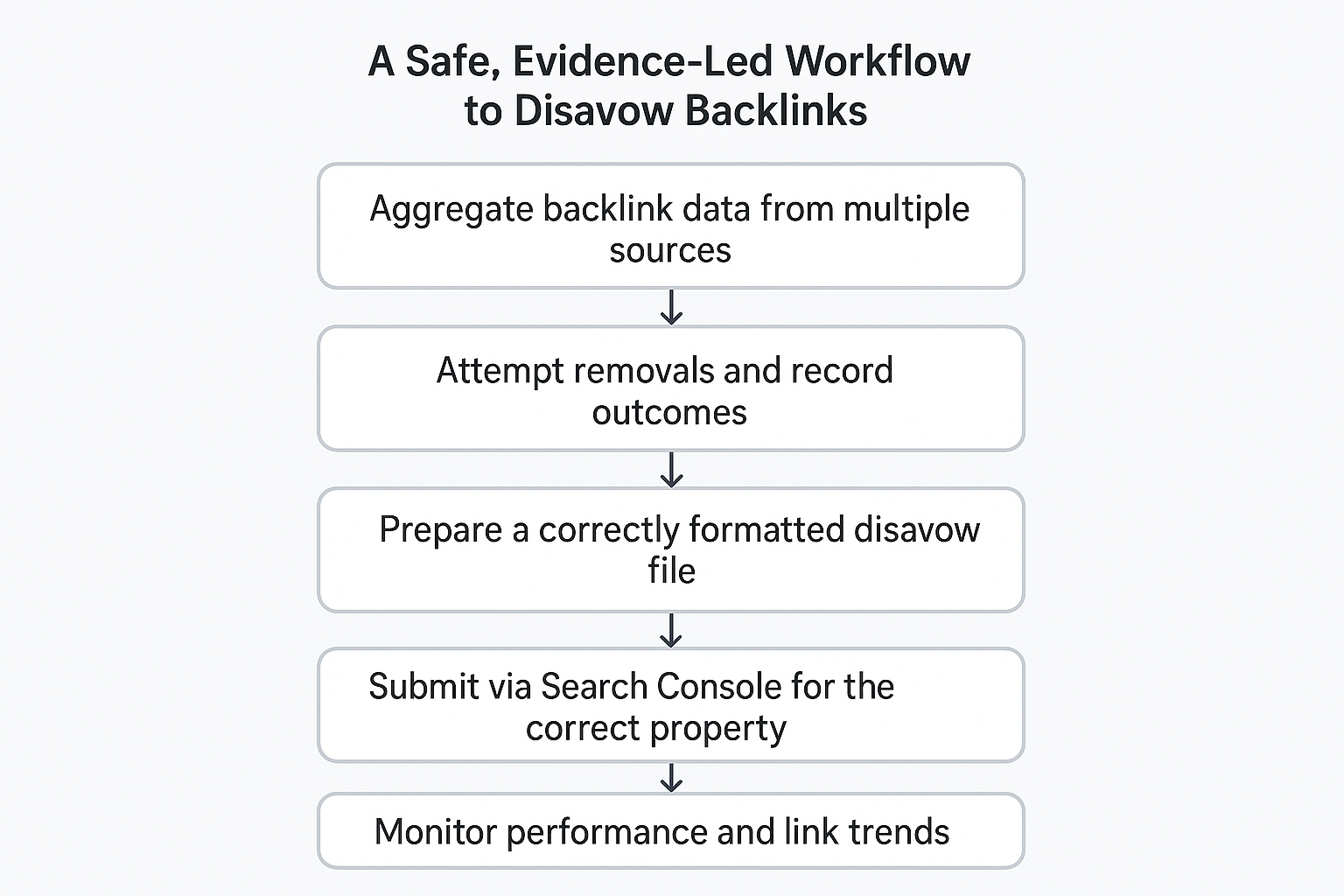
A Safe, Evidence-Led Workflow to Disavow Backlinks
When disavowal is justified, execution discipline is critical, as understanding how to disavow backlinks incorrectly can create more risk than leaving links untouched. A structured approach reduces collateral damage and preserves a defensible audit trail.
A reliable workflow follows five stages, and understanding where the Google disavow process fits within this sequence helps prevent unnecessary or premature intervention.
- Aggregate backlink data from multiple sources
- Attempt removals and record outcomes
- Prepare a correctly formatted disavow file
- Submit via Search Console for the correct property
- Monitor performance and link trends
Backlink disavow should always follow removal attempts, not replace them.
Disavow File Format and Common Errors
A disavow file must be a plain text document using correct syntax. Each line should contain either a single URL or a domain-level directive prefixed with domain. Comments can be added using # for documentation.
Common mistakes include:
- Disavowing entire domains unnecessarily
- Mixing URLs and domains incorrectly
- Using incorrect file encoding
- Failing to track versions and submission dates
These errors can reduce effectiveness or introduce unintended consequences.
What to Expect After Submitting a Disavow File
Disavow directives are processed gradually as search engines recrawl the web, and the Google disavow process does not produce immediate or guaranteed changes in rankings. Effects are rarely immediate and should be evaluated in context.
Monitoring should focus on organic traffic trends, referring-domain quality, manual action resolution and ranking behaviour for priority pages. Recovery is typically incremental. Parallel improvements, such as content quality and legitimate link acquisition, support long-term stability.
To understand whether disavow actions are actually influencing performance, our Data Science & Analytics services connect search signals, traffic trends, and ranking movement to measurable outcomes.
Tools and KPIs for Ongoing Link Health
Search Console provides the authoritative view of inbound links and enforcement actions. Third-party tools help identify patterns and anomalies at scale.
Key metrics to track include:
- Referring-domain relevance
- Anchor text distribution
- Organic search sessions
- Manual action status
Consistent monitoring reduces the likelihood that a backlink disavow will be needed again.
How Seek Marketing Partners Supports Link Remediation
Seek Marketing Partners provides evidence-based backlink audits, removal prioritisation, disavow file preparation, and ongoing monitoring for organisations that require expert support. Their approach emphasises conservative decision-making, documentation, and alignment with broader SEO strategy.
For teams facing penalties, unexplained volatility, or legacy link issues, professional oversight reduces risk and shortens recovery timelines. If you need clarity on whether action is required or confidence that it is not, an expert audit delivers answers grounded in data rather than assumptions.