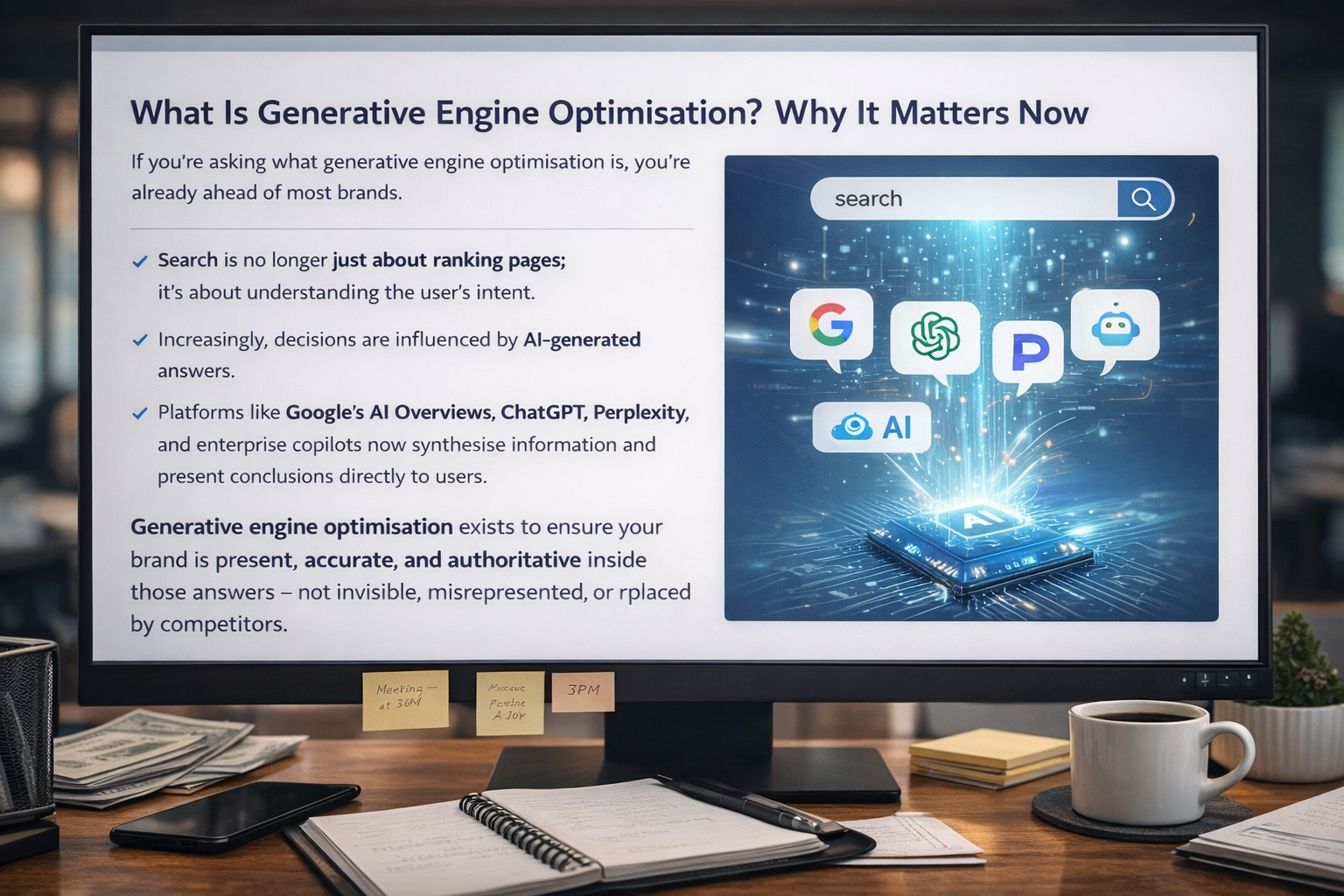
If you’re asking what generative engine optimisation is, you’re already ahead of most brands.
Search is no longer just about ranking pages; it’s about understanding the user’s intent. Increasingly, decisions are influenced by AI-generated answers. Platforms like Google’s AI Overviews, ChatGPT, Perplexity, and enterprise copilots now synthesise information and present conclusions directly to users.
Generative engine optimisation exists to ensure your brand is present, accurate, and authoritative inside those answers – not invisible, misrepresented, or replaced by competitors.
What Is Generative Engine Optimisation?
So, what is generative engine optimisation? It’s the practice of structuring content so AI systems can accurately interpret, trust, and cite it – not just ranked by traditional search algorithms.
Rather than competing for blue-link positions, GEO focuses on being cited in AI-generated responses, shaping how brands, products, and expertise are summarised, and ensuring accuracy when AI interprets complex topics. In short, it’s about influence, not just visibility.
How GEO Actually Works
Generative engines don’t “rank” content in the traditional sense. They interpret, compare, and synthesise information from multiple sources to construct an answer.
Effective GEO aligns content with how these systems evaluate trust and relevance, including:
- Clear entity definitions and consistent terminology
- Structured explanations that answer real questions directly
- Contextual depth rather than surface-level keyword usage
- Signals of authority, accuracy, and corroboration
Content that performs well here isn’t clever or promotional. It’s clear, structured, and difficult to misinterpret.
GEO builds on the same foundations as strong SEO, so if you want to strengthen how your content performs across both traditional search and AI-driven discovery, our search engine optimisation services provide the strategic base to do it properly.
GEO vs Traditional SEO
Traditional SEO is still important, but it’s no longer sufficient on its own. Ranking pages and driving clicks remains valuable, yet it doesn’t fully reflect how people now discover, evaluate, and choose solutions in AI-driven search environments.
SEO focuses on improving page visibility through keywords, links, and technical signals, with success measured in traffic and rankings. It’s designed for a model where users compare results and decide what to click, making it effective for discovery and demand capture.
Generative engine optimisation addresses what happens next. GEO focuses on influencing AI-generated answers by optimising for entities, concepts, and clarity rather than rankings alone. It doesn’t replace SEO. Instead, it extends it into environments where decisions are increasingly being made.
Where GEO Shows Up Today
You’re already seeing the effects, whether you planned for it or not. Generative engine optimisation influences visibility in:
- Google AI Overviews
- ChatGPT and Copilot-style assistants
- Perplexity and answer-first search tools
- Internal AI search tools used by enterprises
In many cases, users never click through to a website. Yet opinions are formed, vendors are shortlisted, and brands are either trusted or ignored.
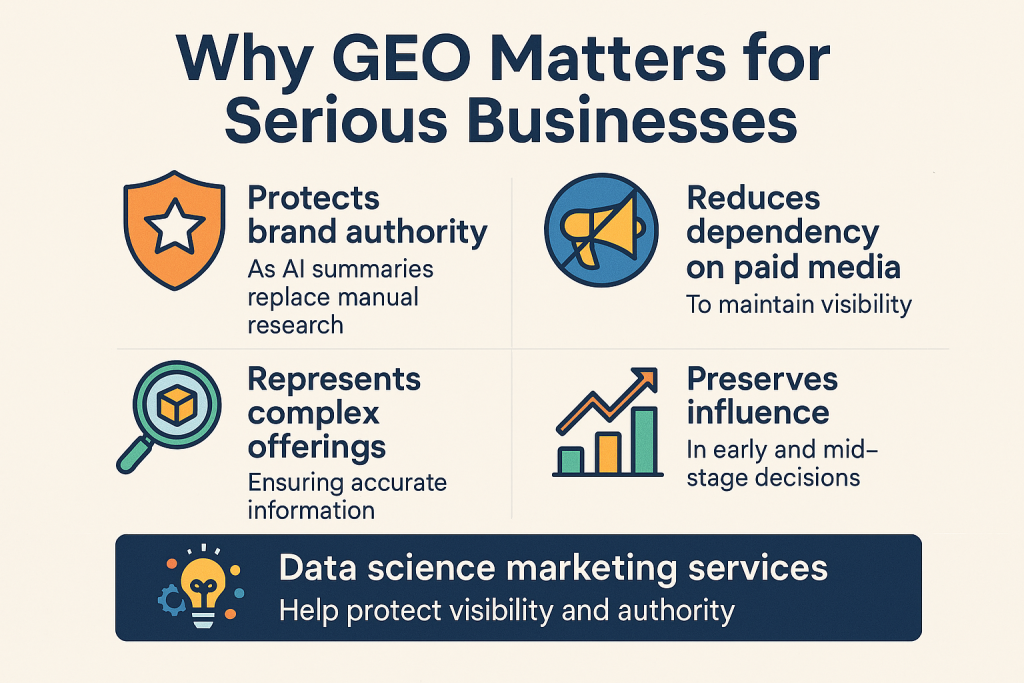
Why GEO Matters for Serious Businesses
For multi-site brands and established organisations, this shift is commercial and not theoretical. GEO helps protect brand authority as AI summaries replace manual research, reduces dependency on paid media to maintain visibility, and ensures complex offerings are represented accurately.
It also preserves influence during early- and mid-stage decision-making, where perceptions are formed long before a click occurs. If your competitors shape the narrative and you don’t, AI systems will still provide answers – just not in your favour.
Because GEO relies on accurate data, measurement, and interpretation at scale, our data science marketing services help brands understand how they’re being represented and make informed decisions to protect visibility and authority.
What Effective GEO Involves
| Strategic content architecture: Content is structured across topics and entities to support authority and consistency, not scattered across disconnected blog posts. | Answer-led structuring: Pages are designed to deliver clear, synthesised answers that AI systems can easily interpret, reference, and reuse. |
| Visibility and representation analytics: Performance is measured by how often and how accurately a brand appears within AI-generated responses, not just traffic metrics. | Continuous optimisation: Content is refined as generative models, prompts, and user behaviours change, ensuring relevance over time. |
Why Most Brands Will Need a Generative Engine Optimisation Agency
Many organisations underestimate how technical and high-risk this space is. Without specialist oversight, AI models can misinterpret brand positioning, inaccurate summaries can persist at scale, and competitors can dominate answers without outranking you.
A dedicated generative engine optimisation agency brings the data, structure, and governance needed to manage this properly – especially for brands operating across multiple markets, products, or locations.
For agencies and in-house teams that need additional expertise or execution capacity, our white-label digital marketing services provide specialist support to deliver GEO at scale, without compromising accuracy or control.
How We Approach GEO
At Seek Marketing Partners, we don’t treat GEO as a trend or an add-on. Our focus is on what generative optimisation actually is in practice: a disciplined, data-led approach to shaping how AI systems understand and represent your brand.
| Analytics-led execution: Decisions are driven by data on visibility, citation, and representation, not assumptions or generic best practices. | Built for scale and complexity: Our approach is designed for organisations with multiple offerings, locations, or markets where precision and consistency matter. |
| Authority and visibility measurement: Success is measured by how often your brand appears, how it is referenced, and how accurately it is represented within AI-generated answers. | Integrated search and content strategy: Generative optimisation is aligned with SEO, content, and wider digital strategy to ensure consistency across all discovery environments. |
We focus on outcomes: how your brand appears, how often it’s referenced, and how reliably it’s understood.
Is Generative Engine Optimisation Replacing SEO?
No, it’s not. But it’s redefining what optimisation actually means. SEO still drives discovery. GEO shapes interpretation and influence. Brands that rely solely on rankings will increasingly find themselves visible but unheard.
Final Thought: Stop Guessing How AI Sees Your Brand
Generative engines are already shaping perception, shortlists, and trust. The only question is whether your brand is actively optimised or passively interpreted.
If you want clarity on how AI systems currently represent your business, and what needs to change, it’s time for a strategic conversation.