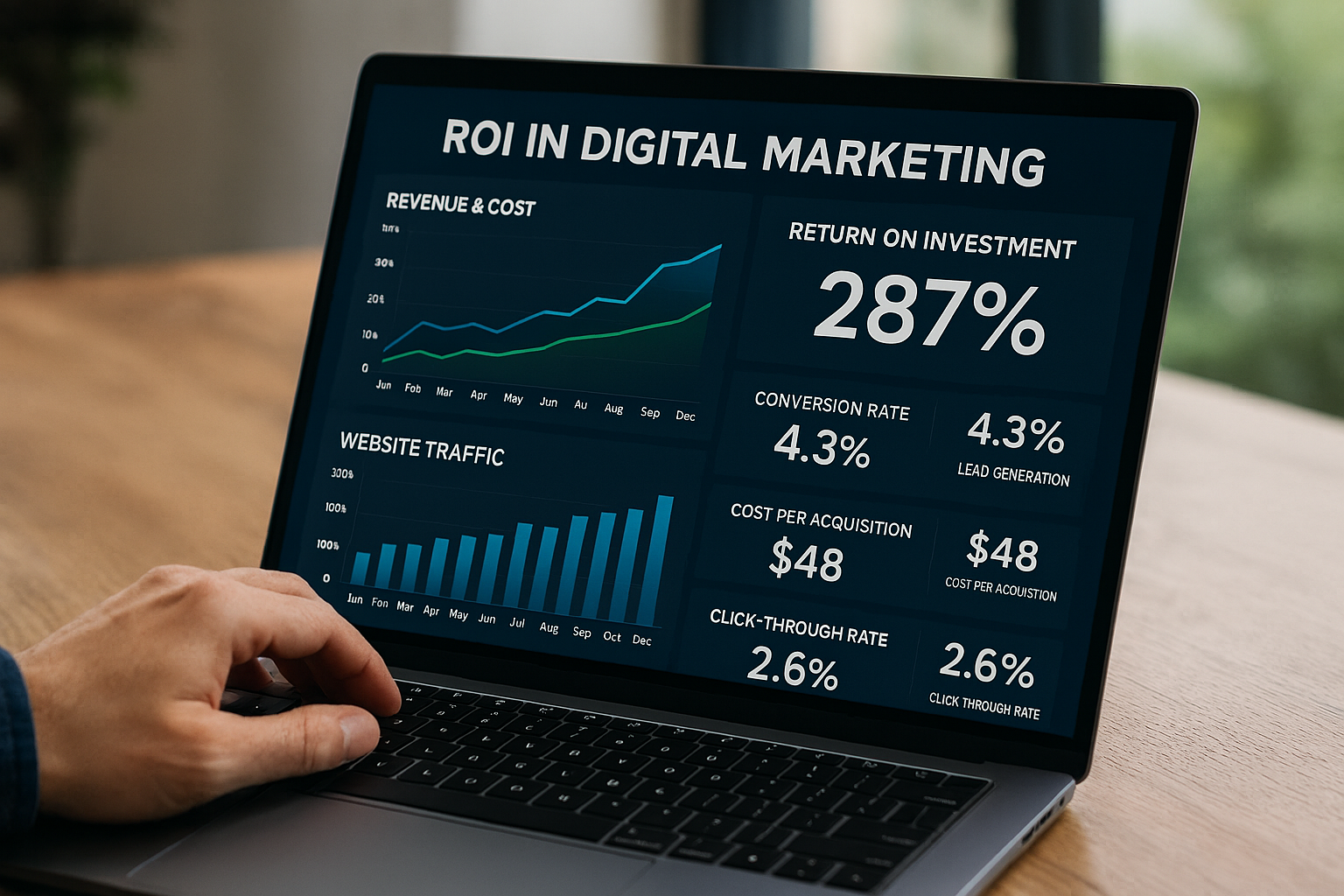
Return on Investment (ROI) in digital marketing measures the profit generated from your marketing activity compared to what you spent. In simple terms, it shows whether a campaign generated more revenue than it cost.
Digital marketing ROI is calculated by taking the revenue (or value) attributed to marketing, subtracting the marketing cost, and dividing the result by the marketing cost. A positive ROI above 0% means your campaign generated more revenue than it cost, while a negative ROI means you spent more than you earned.
Why Do We Have to Measure Digital Marketing ROI?
Measuring ROI in digital marketing is essential for making informed, commercially sound decisions. It helps you:
- Determine campaign success: ROI shows whether a campaign is profitable. Before launching, define a clear ROI target. Afterwards, measure performance against that benchmark.
- Compare channels and strategies: Tracking ROI across channels reveals which activities generate the strongest financial returns.
- Allocate budget wisely: When you identify the campaigns delivering the highest ROI, you can reallocate budget toward high-performing channels and optimise or pause underperforming ones.
- Justify marketing spend: Demonstrating measurable ROI to stakeholders or leadership proves that marketing investment is contributing to business growth.
- Refine strategy: ROI is not a one-off calculation; it supports continuous testing, optimisation and strategic improvement.
In short, focusing on ROI aligns marketing activity with business objectives. It prevents investment in campaigns that appear promising but fail to deliver measurable impact, and it highlights the tactics that genuinely drive results.
How to Calculate ROI in Digital Marketing
The basic digital marketing ROI formula is:
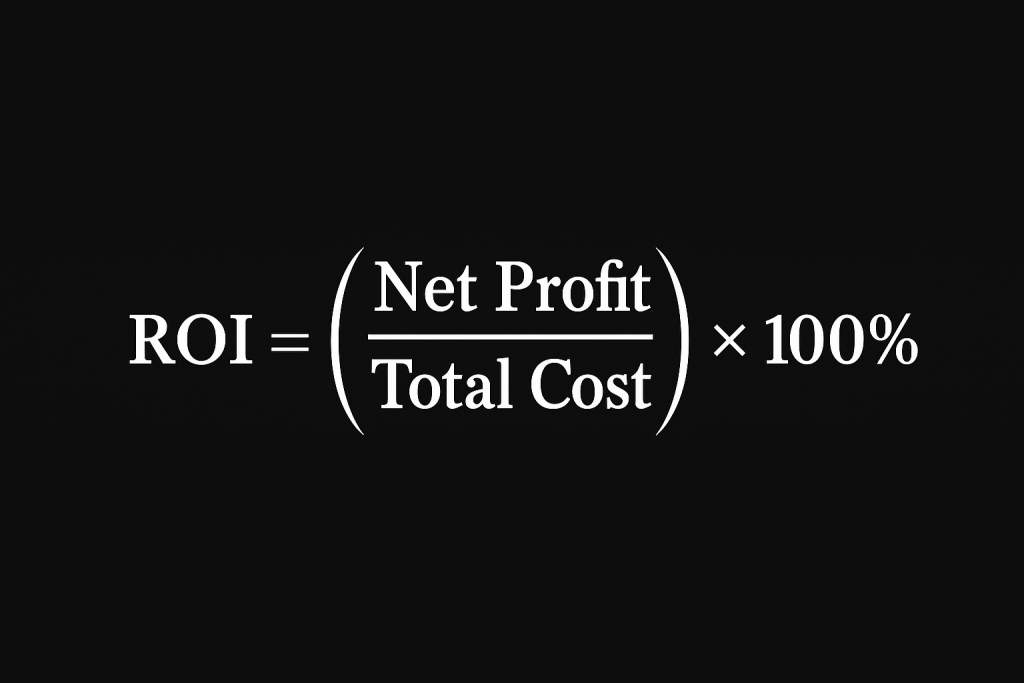
For instance, if a campaign costs £4,000 and generates £18,000 in revenue:
ROI = ((18,000 – 4,000) ÷ 4,000) × 100 = 350%
- 100% ROI means you generated profit equal to your initial investment (you doubled your money in total revenue terms).
- 350% ROI means you generated £3.50 in profit for every £1 spent, in addition to recovering your original £1.
Steps to calculate ROI
- Determine total campaign revenue: Track the sales or value directly attributable to the campaign. This could be online purchases, or for lead generation, estimated deal values based on historical close rates.
- Sum all marketing costs: Include ad spend, agency fees, software tools, creative production, and any associated overhead. Be as comprehensive as possible to avoid overstating ROI.
- Apply the formula: Subtract total cost from revenue to determine profit, divide by total cost, then multiply by 100 to calculate ROI as a percentage.
| Here’s an example. A company predicts 1,000 leads from a campaign, expects 25% to convert into customers, and the average order value is £50. Predicted revenue = 1,000 × 0.25 × £50 = £12,500 If the campaign costs £5,000: Predicted ROI = ((12,500 – 5,000) ÷ 5,000) × 100 = 150% |
It’s important to note that this formula does not capture every variable. For a more complete view of performance, supplement ROI with metrics such as cost per lead, conversion rate and customer lifetime value (CLV).
The Difference Between ROI and ROAS
ROI measures overall profit from marketing activity, while Return on Ad Spend (ROAS) focuses specifically on revenue generated from paid advertising.
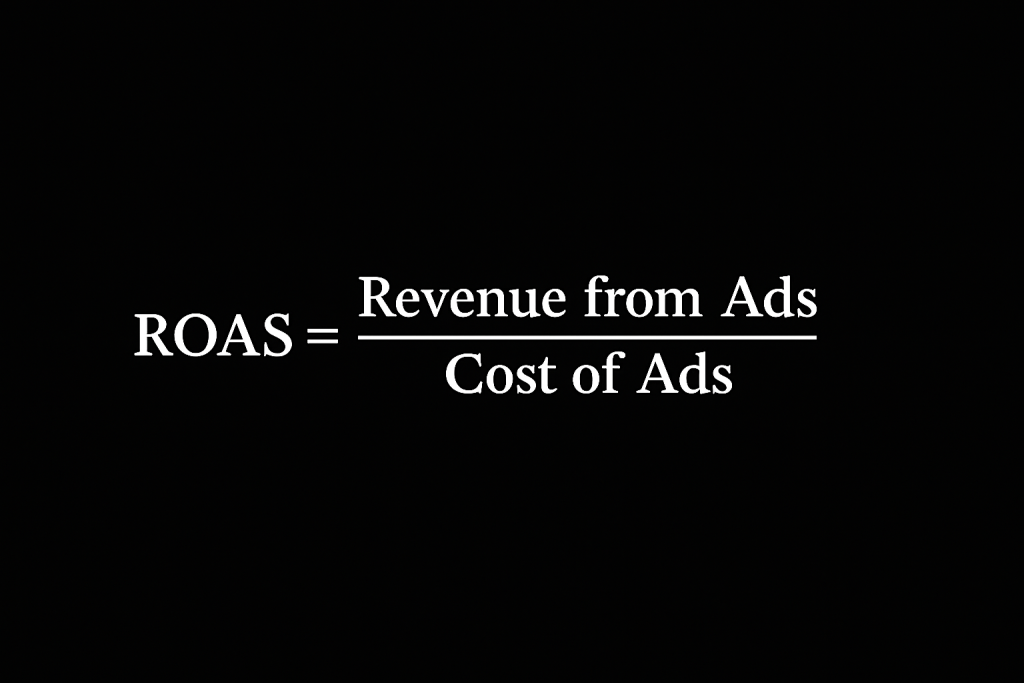
For example, a paid campaign might achieve an 800% ROAS (eight times return on ad spend), but overall ROI would also account for additional costs such as software, creative production, agency management and staff time.
Both are useful: ROAS helps evaluate paid media efficiency at a channel level, while ROI provides a broader view of true profitability.
The Key Metrics and Considerations
Calculating ROI is essential, but understanding why it is high or low requires analysing supporting metrics. Key performance indicators include:
- Impressions or Page Views: These reflect visibility and brand exposure. Efficient awareness campaigns often deliver high reach at a controlled cost per impression.
- Click-through Rate (CTR): A higher CTR suggests your ads or content resonate with the audience. Strong CTR can improve Quality Score in paid media, often reducing cost per click and improving overall return.
- Cost per Lead (CPL) and Cost per Acquisition (CPA): CPL measures how much it costs to generate a lead, while CPA measures the cost to acquire a customer. These metrics directly influence profitability.
- Conversion Rate: The percentage of visitors who complete a desired action (purchase, sign-up, enquiry, etc.). Even small improvements here can greatly improve ROI.
- Average Order Value (AOV): The average transaction value. Increasing AOV through cross-sells, bundles or upsells raises revenue per customer without increasing acquisition cost.
- Customer Lifetime Value (CLV): The total projected revenue generated by a customer over time. A higher CLV can justify higher acquisition costs or lower short-term ROI.
Tracking these metrics within analytics platforms ensures data accuracy. Incomplete or inaccurate tracking leads to distorted ROI calculations. Implement proper conversion tracking and use UTM parameters to attribute traffic sources correctly, ensuring revenue is linked to the right campaigns.
What Is a Good ROI?
A “good” ROI in digital marketing depends on context, but a commonly cited benchmark is a 5:1 ratio – generating £5 in revenue for every £1 spent (500% ROI).
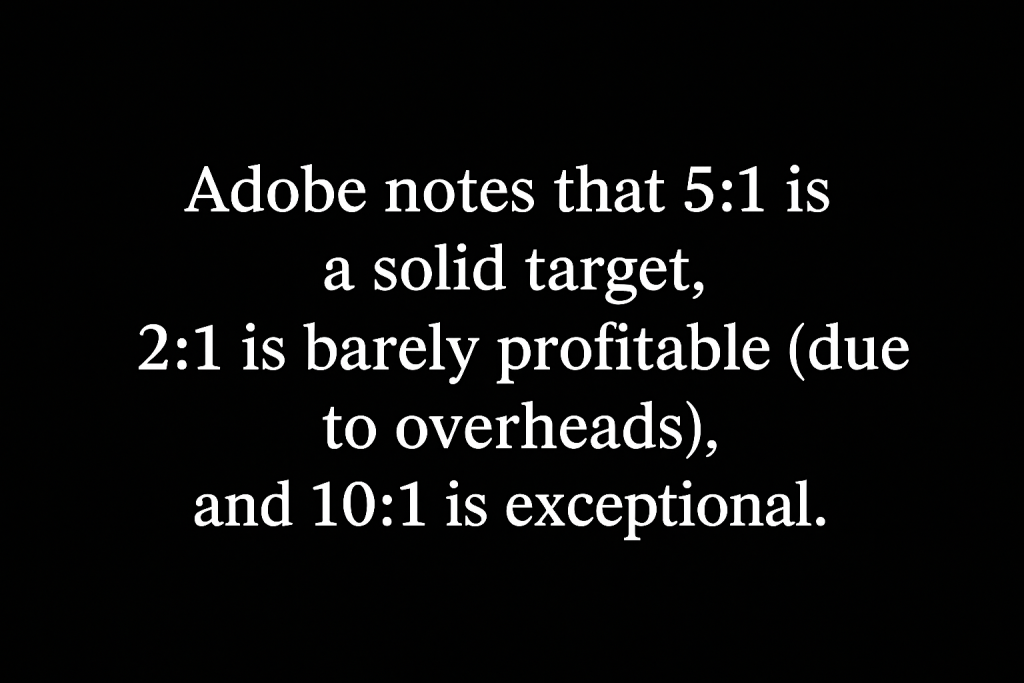
In practice, acceptable ROI varies by industry, margin structure and campaign objective. High-margin businesses can tolerate higher acquisition costs, while competitive or low-margin sectors may operate on tighter returns. Some strategies prioritise long-term customer value over immediate profit.
Rather than chasing a fixed number, set ROI targets aligned with your commercial model. Brand or awareness campaigns may not deliver immediate 5:1 returns, and that can be acceptable if they contribute to long-term revenue growth. The key is setting realistic benchmarks based on historical performance and market conditions.
Learn How to Improve Your Digital Marketing ROI
Calculating ROI in digital marketing is only the starting point; improving it requires structured optimisation. Here are practical strategies:
Set Clear Goals and KPIs
Before launching any campaign, define measurable objectives. Clear KPIs guide budget allocation and allow ROI to be evaluated accurately.
Focus on High-Performing Channels
Avoid spreading budget too thinly. Identify which channels consistently generate strong returns and prioritise investment there.
Continuous A/B Testing
Test variations in ad copy, landing pages, email subject lines and creative assets. Even small improvements in conversion rate can materially increase ROI over time.
Use Advanced Attribution
Modern customer journeys are rarely single-touch. Multi-touch attribution models provide a more accurate picture of ROI than last-click attribution alone.
Optimise Conversions
Improving conversion rate and average order value (AOV) can significantly impact ROI without increasing traffic. For example, increasing conversion from 5% to 6% represents a 20% uplift in conversions and often a comparable uplift in return.
Invest in Analytics and Reporting
Clean, reliable data is essential. Accurate tracking ensures ROI calculations reflect real performance rather than incomplete attribution or missing costs.
Experiment with Offers
If performance plateaus, test pricing structures, bundles or limited-time incentives. Stronger offers can improve conversion rates, provided margins remain protected.
Seasonal Adjustments
Performance often fluctuates seasonally. Evaluate ROI across comparable time periods before pausing campaigns. Adjust targets to reflect peak and off-peak demand.
Leverage Technology
Modern analytics platforms, including Google Analytics and predictive audience tools, can help identify segments with higher conversion potential. Automation and reporting tools improve visibility and speed of optimisation.
The Role of a Specialist Digital Marketing Agency in ROI
If you’re aiming to improve your ROI, partnering with a data-driven digital marketing agency like us can accelerate results. At Seek Marketing Partners, we offer services like PPC advertising and CRO optimisation specifically to boost ROI. Whatever service you need – whether SEO, social media, email – our focus is always on measurable growth.
Ultimately, the goal is that every pound spent moves the needle. If you need help calculating or improving your digital marketing ROI, get in touch with us.