
If August has taught us anything, it’s that digital marketing isn’t slowing down.
AI search is becoming more measurable, Google has given publishers greater control over how their content appears in generative search, another spam update has shaken up rankings, and even the definition of “SEO visibility” is stretching beyond your website and into social platforms.
In other words, there’s quite a bit to catch up on.
In this edition of our newsletter, we’re breaking down the most important digital marketing updates August 2026 has brought us. And as usual with the SMP team, you’ll find no vague predictions or unnecessary jargon here. Instead, we’ll quickly and clearly break down what has actually happened, why it matters to your business, and, most importantly, what you should be doing about it.
Some of these developments are still evolving (particularly when it comes to generative AI), so where that’s the case, we’ll say so. There’s enough uncertainty in digital marketing already without us adding to it.
Contents & Key Takeaways
Short on time? Here’s the quick version of the latest news in SEO and digital marketing this month:
- Google gives websites more control over AI Search: New Search Console reporting shows visibility in AI Overviews and AI Mode, while a new Google AI opt out control is being tested for publishers who don’t want their content included.
- Google launches another spam update: The Google spam update August rollout took place 18 – 21 August, continuing Google’s efforts to tackle tactics that undermine search quality.
- Cloudflare bot controls need checking: New bot-management options make it increasingly important to understand exactly what you’re blocking, or you risk legitimate search crawlers getting caught in the crossfire.
- AI visibility gets easier to measure: Google and Bing are both giving website owners more information about visibility inside AI-generated experiences, making GEO analytics considerably more accessible and useful.
- Google tightens review standards: Fake and undisclosed incentivised reviews are firmly in Google’s sights, with businesses needing to pay closer attention to both review acquisition and structured data.
- SEO is becoming increasingly cross-platform: Google Search Console can now report on the performance of Instagram, TikTok, X and YouTube content, giving cross platform SEO a much more tangible role in search strategy.
- GEO continues to evolve: Changes to ChatGPT citations and Google’s Preferred Sources features reinforce why Generative AI SEO needs to be treated as an emerging visibility channel, not simply traditional SEO with a new name.
- BONUS: Is Google Preparing an ‘AI Content Crackdown’?: The August spam update re-ignited discussion around Google and AI content. We’ll take a look at the relationship between the two, what’s changing, and what it means for businesses.
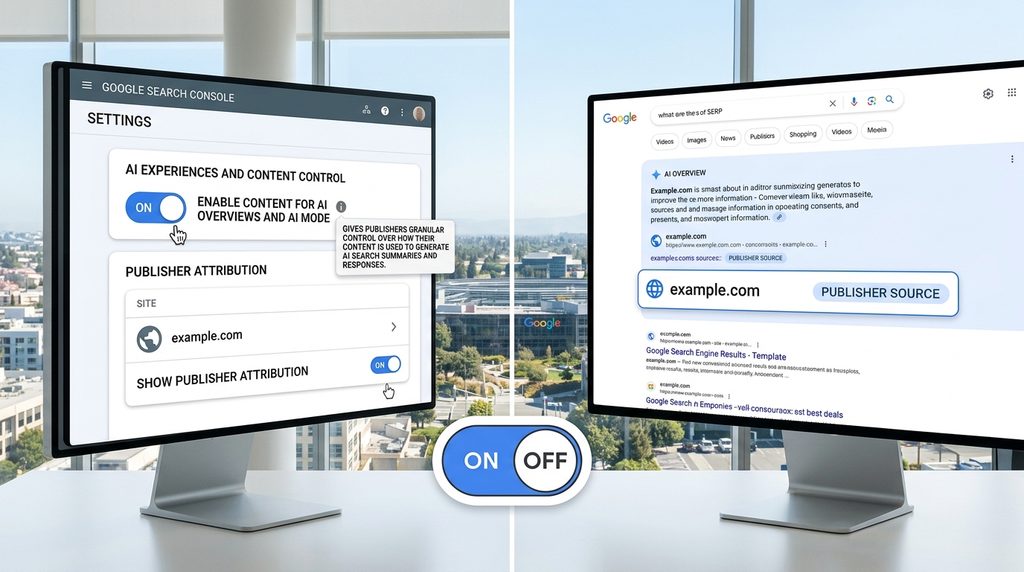
1. Google Gives Publishers More Control Over AI Overviews and AI Mode
One of the biggest digital marketing updates of August 2026 is actually the continuation of something Google started rolling out earlier this summer.
Google has introduced dedicated Generative AI performance reporting within Search Console. It shows impressions from AI Overviews and AI Mode alongside information including pages, countries, devices and dates. At the moment, Google says the reports are still being rolled out to a subset of websites.
Perhaps more importantly, Google is also testing a new Search Console control that allows eligible website owners to decide whether their content can appear in and help ground responses in AI Overviews, AI Mode and generative AI features within Discover.
That gives publishers a genuine Google AI opt out without sacrificing their conventional organic rankings. Google explicitly states that choosing not to participate will not be used as a ranking signal outside its generative AI features.
Why it matters
Until now, one of the frustrations surrounding AI search has been the lack of control and transparency.
The new system begins to separate two decisions that were previously difficult to disentangle: “Do we want to appear in Google Search?” and “Do we want our content used within Google’s generative AI search experiences?”
For publishers especially, that distinction matters. AI-generated answers can provide visibility, but they may also answer a searcher’s question without requiring a visit to the original website.
We wouldn’t recommend rushing to switch anything off. We would recommend measuring what AI visibility is actually doing for you before making that decision.
What to do about it
- Check Search Console to see whether your property has received access to the Generative AI performance report and AI control.
- Establish a baseline for your AI impressions before making any changes.
- Identify which pages receive the most visibility through AI Overviews and AI Mode.
- Weigh AI visibility against traffic, conversions, brand exposure and your wider commercial objectives.
- If you test the opt-out, document the date so subsequent performance changes can be measured properly.

2. Google’s August 2026 Spam Update Rolls Out
Google officially began rolling out its Google spam update for August on the 18th. According to Google’s Search Status Dashboard, the rollout finished on August 21st after approximately two days and 16 hours. It was the third confirmed spam update of 2026, following updates in March and June.
Google hasn’t published a neat list saying, “Here are the exact websites we’re coming after.” It rarely does.
The important context is Google’s long-running effort to reduce the visibility of content and tactics that manipulate rankings rather than genuinely helping searchers. That means anyone seeing movement following the update should diagnose the cause rather than assuming every ranking drop is simply “Google being Google”.
Why it matters
Spam updates can create winners as well as losers.
If their competition has been benefiting from manipulative tactics and those tactics stop working, more legitimate websites can gain visibility without changing anything themselves. Equally, businesses relying on questionable link-building, mass-produced low-value pages or other search-first tactics can suddenly discover how fragile those rankings were.
That’s why our response to an algorithm update is rarely to start changing everything immediately.
Ranking volatility during and shortly after a rollout is normal. The useful work starts when we have enough data to distinguish an actual trend from temporary movement.
What to do about it
- Compare organic visibility before and after the rollout, looking at individual pages and query groups rather than just total traffic.
- Check whether losses are concentrated around particular content types, templates, directories or sections of your site.
- Review content for originality, genuine expertise and usefulness rather than trying to hit an arbitrary word count.
- Audit suspicious or historically aggressive SEO tactics rather than looking for a quick “fix”.
- If rankings haven’t changed significantly, don’t manufacture a problem. Keep doing what the data says is working.
The glamorous answer would be that there’s a secret trick to beating every Google update. There isn’t. Our advice is to follow this golden rule: “Build useful things properly and measure them properly”. It remains surprisingly effective.

3. Cloudflare Bot Controls Could Have SEO Consequences
Next in our list of digital marketing updates for August 2026, we touch on something that has been around for a long time – bot management. It’s an area that is definitely becoming more complicated, because “bot” no longer means one thing.
Cloudflare now distinguishes between automated crawlers used for Search, AI Training and Agent activity, and it has announced further changes to its default AI bot policies from September 15th. Its documentation specifically warns that mixed-purpose crawlers can fall under broader blocking configurations.
That creates a potential SEO problem: security rules intended to block unwanted automated traffic can be too broad.
This is where the current conversation around Cloudflare blocking Googlebot becomes more relevant. Googlebot itself remains a recognised search crawler, and Cloudflare provides specific guidance for allowing verified search engine bots. But custom WAF rules, challenges or overly aggressive configurations can still cause legitimate crawler traffic problems if they aren’t set up correctly.
Why it matters
If Google can’t reliably crawl important pages, it can’t reliably index and rank them.
The tricky part is that a business may tighten its security or AI crawler rules with perfectly sensible intentions, and only discover the SEO consequences later.
As platforms introduce more granular distinctions between search crawlers, AI training crawlers and AI agents, technical SEO and website security increasingly need to speak to one another.
“Block the bots” is no longer a sensible blanket instruction.
What to do about it
- Review Cloudflare WAF, bot-management and AI crawler settings, particularly if they have recently changed.
- Confirm that Googlebot and other verified legitimate search crawlers can reach the pages you want indexed.
- Check Google Search Console for crawl anomalies, indexing changes and unexpected drops in discovered URLs.
- Review server logs where possible to see how crawler requests are actually being handled.
- Re-test crawlability whenever security or bot-management rules are changed.
Cloudflare itself recommends reviewing bot traffic before altering settings. That’s sensible advice: know what you’re blocking before you block it.

4. GEO Analytics Get a Boost From Google and Bing
For quite a while, one of the biggest problems with AI search has been measurement.
You could optimise content, see your brand occasionally appear inside an AI answer, and then… well, hope for the best.
That’s starting to change.
As we mentioned earlier, Google is testing dedicated Search Console reporting for generative AI visibility. Meanwhile, Bing introduced AI Performance within Bing Webmaster Tools earlier this year, providing data on how publisher content appears across Microsoft Copilot, AI-generated Bing summaries and selected partner integrations.
Bing’s reporting includes citation activity and visibility into which URLs are referenced, while Google’s current report focuses heavily on impressions and the pages appearing within generative features.
All of this means we’re now finally getting some proper GEO analytics rather than relying exclusively on manual searches and third-party monitoring tools.
Why it matters
Traditional SEO has a relatively mature measurement stack. We can analyse impressions, clicks, rankings, sessions, conversions and revenue.
Up to now, the inner workings behind AI discovery have been much more of a mystery.
Better native reporting means businesses can start asking more useful questions like:
- Which pages are appearing?
- Which subjects generate AI visibility?
- Are citations increasing?
- Does greater AI visibility correspond with branded search, direct traffic, leads or sales?
It also reinforces an important point: a citation and a website visit are not the same thing. That means GEO shouldn’t be judged purely on referral sessions. Its impact may appear elsewhere in the customer journey.
What to do about it
- Check both Google Search Console and Bing Webmaster Tools for the latest AI reporting available to your properties.
- Track AI visibility separately from conventional organic rankings and clicks.
- Identify content that earns repeated impressions or citations and look for common characteristics.
- Add AI referrals to your analytics reporting, but don’t treat referral traffic as the only measure of value.
- Monitor branded search, direct visits and assisted conversions alongside AI visibility where your data allows it.
Measurement isn’t perfect yet. It is, however, getting considerably better.
5. Google Gets Tougher on Fake and Incentivised Reviews
Reviews are incredibly powerful. Unfortunately, that’s precisely why people keep trying to game them.
Google’s current policies make it clear that businesses must not offer payment, discounts, free products or services in exchange for Google Maps reviews. Google classifies incentivised or biased reviews as rating manipulation and states that offending content may be removed.
The rules also matter beyond the reviews displayed directly on your Google Business Profile.
Google’s structured-data documentation now explicitly warns against marking up fake or undisclosed incentivised reviews. If an incentive genuinely exists, it must be clearly and prominently disclosed. Google also requires marked-up review content to be visible to users on the page rather than existing purely for search engines.
So, if you’re wondering how to remove fake Google reviews or avoid review-related problems in the first place, the answer starts with having a legitimate, transparent review process.
Why it matters
Reviews influence trust, local visibility and buying decisions. That can make employing dodgy review tactics tempting, but our advice is this – the short-term boost isn’t worth building your reputation on data you can’t trust.
There’s another side to this too though: fake negative reviews can hurt legitimate businesses.
A proper review-management process therefore needs to cover both sides: acquiring genuine feedback without manipulation, and identifying potentially fraudulent reviews that should be reported through the appropriate platform processes.
What to do about it
- Stop any review campaign that rewards customers specifically for posting or changing a Google review.
- Make review requests neutral: ask genuine customers for honest feedback rather than demanding five stars.
- Regularly audit Google reviews for suspicious patterns or reviews that appear unrelated to genuine customer experiences.
- Report reviews that violate Google’s policies rather than attempting to bury them with artificial positive feedback.
- Audit review structured data to ensure ratings and reviews are genuine, visible and compliant with Google’s guidelines.
Real reviews from real customers. Revolutionary stuff for some people, apparently. Not us though! Use the button below to take a look at our Google reviews now.
Or, if you’re more interested in learning about the kinds of projects we’ve worked on and the results we’ve achieved for our clients perhaps the case studies button would fit the bill better?
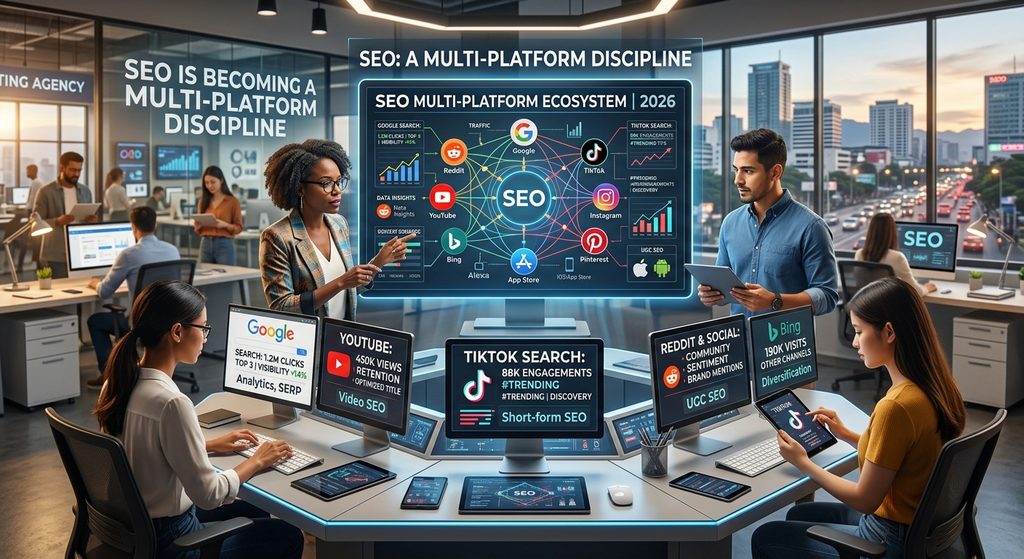
6. SEO Is Becoming a Multi-Platform Discipline
For years, SEO reporting has primarily revolved around your website.
Google has now made that view look increasingly outdated.
In July, Google introduced Platform Properties within Search Console, and by the end of the month the feature had rolled out globally. It allows businesses and creators to see how content published on Instagram, TikTok, X and YouTube performs across Google Search, Discover and Google News.
Among other things, businesses can see which search queries lead people to their social and video content.
That is a fairly significant development for cross platform SEO, because Google is effectively acknowledging something marketers have known for a while: your discoverability doesn’t begin and end with pages hosted on your own domain.
Why it matters
Search behaviour is fragmented.
People look for products on Google, watch reviews on YouTube, search TikTok for recommendations, check Instagram for examples and increasingly ask AI tools for an answer before they ever reach a company website.
A sensible multi platform SEO strategy therefore asks a wider question than “Where does our website rank?”
It asks: “When somebody looks for information relevant to our business, where do we appear?” or in not-quite-so-many words, “Where do people learn about us?”
Google bringing social and video performance into Search Console makes that question easier to answer.
It also creates opportunities for SEO, content and social teams to stop operating as separate islands. Search data can help shape social content, while successful social content can tell your SEO team which topics and formats audiences actually respond to.
What to do about it
- Add relevant Instagram, TikTok, X and YouTube properties to Search Console where available.
- Identify queries already generating visibility for your social and video content.
- Compare topics that work on your website with those gaining traction through external platforms.
- Build search intent into video and social planning rather than treating optimisation as something that happens after publishing.
- Report on brand visibility across channels instead of relying on website rankings alone.

7. Generative AI SEO Enters Its Next Phase
We’ll close out our roundup of digital marketing updates for August 2026 with a story that’s less about one isolated update and more about where search appears to be heading.
During August, some users and industry observers reported that ChatGPT’s full Sources panel had become less prominent, moving behind the three-dot menu in certain sessions. Importantly, citations themselves had not disappeared, and OpenAI continues to document inline citations and a Sources interface as part of ChatGPT search. There has also been no official confirmation that the observed UI change represents a universal permanent rollout.
At roughly the same time, citation-tracking data showed how volatile AI visibility can be. Promptwatch data reported by Axios found Reddit’s average share of ChatGPT Search citations fell sharply in August, demonstrating just how quickly source-selection patterns can change.
Google, meanwhile, continues moving in the opposite direction on publisher personalisation. Its Preferred Sources system has expanded into AI Overviews and AI Mode, and August brought additional controls allowing users to prioritise favourite publishers across Google experiences.
Welcome to Generative AI SEO.
Why it matters
The big lesson here isn’t that “ChatGPT changed a button”.
It’s that AI discovery is volatile.
Brands can be mentioned without being clicked. Sources can gain or lose citation visibility quickly. Different AI platforms can favour different content, and interfaces determining whether users ever visit the source can change too.
That makes GEO different from chasing a conventional number-one ranking.
The objective is broader: build a brand and body of content that search engines and generative systems can understand, trust, retrieve, cite and recommend.
What to do about it
- Track brand mentions and citations across major AI platforms rather than focusing on one engine.
- Keep technically important AI search crawlers accessible where AI visibility is part of your strategy.
- Publish genuinely useful, original and clearly structured information that gives generative systems something worth citing.
- Measure citations alongside branded searches, direct traffic, leads and conversions rather than obsessing over referral clicks alone.
- Don’t chase every short-term GEO fluctuation. Build authority across your website and the wider platforms your audience uses.
OpenAI itself advises publishers that allowing OAI-SearchBot helps content become discoverable, surfaced and cited within ChatGPT search.

BONUS: Is Google Preparing an ‘AI Content Crackdown’?
Google’s August spam update has reignited discussion about a potential ‘AI content attack’ from Google, with some questioning whether AI-generated pages could soon face tougher treatment in search.
For now, though, the relationship between Google and AI content remains where it’s been for some time: Google doesn’t automatically penalise content because AI helped create it. Its own guidance says generative AI can be useful for creating original content. The problem comes when automation is used to create large volumes of low-value content primarily to manipulate rankings.
Why it matters
If Google gets better at identifying scaled, low-value AI content, businesses relying heavily on it could be vulnerable to significant ranking losses.
But that doesn’t mean abandoning AI. Used properly, it can improve productivity without compromising quality. The important distinction is whether you’re using AI to help create something valuable for people, or simply to manufacture pages for search engines. Google’s current spam policies explicitly make that distinction.
What to do about it
- Keep Google’s ‘people-first’ content principles at the centre of your strategy.
- Use AI as a tool, but add genuine human expertise, review and original value.
- Avoid mass-producing unoriginal pages simply to capture search traffic.
- Don’t use automation to exploit another website’s authority or otherwise manipulate rankings.
- Audit existing AI-heavy content now rather than waiting for an algorithm update to expose problems.
Our view? Businesses probably have around six to eight months to prepare for this. That’s our estimate, not a deadline from Google, but we wouldn’t wait for any actual crackdown to start taking effect before changing course.
Why Trust Seek Marketing Partners for Digital Marketing News?
There is no shortage of digital marketing commentary online, and that can make separating ‘meaningful insight’ from ‘noise’ tricky.
At Seek Marketing Partners, we’ve been tracking, testing and reacting to changes in the digital landscape for nearly a decade. Across our team, that adds up to decades of combined experience covering SEO, paid media, websites, content, analytics, social and the wider digital ecosystem.
More importantly, our opinions aren’t formed purely by reading somebody else’s opinions.
We work with around 50 different businesses across a wide range of different industries, services and niches. That kind of client base means we have access to a broad array of real-world data showing what is actually happening across different websites, sectors and campaigns.
It all adds up to mean that when Google launches an update, we can look at real metric data for things like rankings, traffic and conversions. When search behaviour changes, we can look at what users are actually doing on different platforms and in different niches. When a new marketing trend appears, we can compare the hype with the numbers and draw meaningful conclusions.
No panic. No crystal ball. No pretending we know something the platforms haven’t actually confirmed. Just experienced marketers looking at real data and telling you what we’re seeing in plain English.
But Why Take Our Word For It?
We’re not an impartial source, we want you to like us and seek out our services (no pun intended) and we admit that.
Instead, we’ll point you towards our collection of case studies and Google reviews. There you’ll find impartial takes on our work, and the kinds of real-world results that we can deliver – so please do take a look, we’re sure you’ll like what you see!
Other Ways Seek Marketing Partners Can Help You
Keeping you informed is useful. Helping you actually do something with that information is better.
Seek Marketing Partners is a full-service digital marketing agency based in Greater Manchester. We help businesses diagnose marketing problems, identify where the real opportunities are and build practical strategies around evidence rather than guesswork.
Whether you need one specialist service or a joined-up approach across your entire digital presence, our team can help in the following ways:
SEO
Technical, on-page and off-page SEO strategies built around real search data, commercial objectives and sustainable organic growth.
PPC Ads
Data-led paid advertising campaigns designed to reach the right audiences, make the most of your budget, avoid waste, and turn clicks into measurable commercial results.
Web Design & Development
Fast, functional and conversion-focused websites that look the part while giving users and search engines exactly what they need.
Content Marketing
Useful, search-informed content created around what your customers actually want to know, helping build visibility, authority and trust.
Social Media Marketing
Strategic social campaigns that put your brand in front of relevant audiences and turn consistent activity into measurable business value.
Email Marketing
Targeted email strategies designed to nurture prospects, strengthen customer relationships and make better use of the audience you already own.
Graphic Design
Professional, brand-consistent creative that makes your marketing clearer, more engaging and more effective across digital and offline channels.
Data Science & Analytics
We turn messy marketing data into useful insights, helping you understand what’s working, what isn’t and where opportunities are hiding.
Conversion Rate Optimisation
We analyse how people actually use your website, identify friction, and test improvements designed to turn more visitors into customers.
Digital PR
Strategic digital PR campaigns designed to earn attention, strengthen authority and secure valuable coverage and links from relevant publications.
Lead Generation
Data-informed campaigns focused on attracting the right prospects and creating a reliable pipeline of genuine opportunities for your sales team.
White Label Support
Flexible white label digital marketing expertise for agencies that need additional capacity, specialist skills or dependable delivery behind the scenes.
Keep Up With the Latest Digital Marketing Changes
If there’s one takeaway from this month, it’s that digital visibility is becoming broader and more complicated.
Google Search now overlaps with generative AI. Social content can become a search asset. AI platforms are developing their own citation ecosystems. Technical decisions about bots can affect discoverability, while reputation signals such as reviews remain under increasing scrutiny.
Getting SMP on Your Side
‘Complicated’ doesn’t have to mean ‘chaotic’ though. If you like what you’ve read here and you’d like our support navigating the often complex, fast-moving landscape of digital marketing, there are 2 main ways that we can do that:
Keeping You Informed
Instead of coming here, we can keep you up to speed by delivering future news roundups to your inbox. All you need to do is fill out the short signup form below!
Becoming Your Digital Marketing Partner
If you’d like more practical help through any of the services and areas of expertise we mentioned in the grid you saw earlier, the first step is to get in touch with our team using the button below!